



Newsletter Subscribe
Enter your email address below and subscribe to our newsletter

Ideas Worth Building

Psychodrama therapy uses role-play, enactment, and group reflection to explore emotions and relationships. Here is how it works, what the evidence suggests, and why it should be considered cautiously alongside more established therapies.
Psychodrama therapy can sound immediately compelling: instead of only talking about a painful memory, conflict, or relationship pattern, a person may be invited to enact it, reverse roles, speak from another perspective, or watch an experience played back by others. That action-based format is what makes psychodrama distinctive. It is also what makes careful explanation important.
Psychodrama is often discussed alongside theater therapy, experiential psychotherapy, alternative therapy, and group psychotherapy. But it should not be presented as a proven replacement for better-established treatments such as cognitive behavioral therapy, trauma-focused CBT, EMDR for PTSD, or structured evidence-based group therapy. The research literature suggests possible benefits in some settings, while also showing important limitations in study size, design, consistency, and follow-up.
This research summary explains what psychodrama therapy is, how it usually works, what techniques are commonly used, how it compares with more established psychotherapy techniques, and what the evidence can and cannot currently support.
Psychodrama therapy is an experiential, action-oriented form of psychotherapy associated with Jacob L. Moreno. Rather than relying only on verbal discussion, psychodrama uses enactment, role-play, group interaction, and reflection to explore emotions, relationships, identity, conflict, and past, present, or imagined situations.
In plain language, psychodrama asks people to show an experience, not just describe it.
A participant may act out a conversation with a parent, rehearse a future interaction, explore an inner conflict, or step into the role of another person. Other group members may assist by playing roles, reflecting what they observed, or sharing emotional responses after the enactment.
Although psychodrama can be used in individual formats, it is commonly practiced in groups. The group setting matters because psychodrama often relies on interpersonal feedback, shared witnessing, and participation from others. In that sense, it overlaps with group psychotherapy, but it is more structured around action and enactment than many standard process-oriented therapy groups.
A psychodrama session can vary depending on the clinician, setting, and population. However, many sessions include three broad phases.
The warm-up phase helps participants become present, emotionally engaged, and connected to the group. This may include discussion, movement, sociometric exercises, or prompts that help identify themes for the session.
Sociometry is a psychodrama-related method for exploring relationships and group dynamics. For example, participants may be asked to physically position themselves in a room according to shared experiences, levels of comfort, or relational patterns. The goal is not performance, but increased awareness of interpersonal connections and emotional material.
The action phase is the central psychodramatic work. One participant, often called the protagonist in psychodrama language, explores a scene or issue with help from the therapist and, in groups, other members.
The scene may involve a real memory, an unresolved conflict, a feared future event, a symbolic image, or an internal dilemma. The therapist guides the process and may pause, redirect, or deepen the enactment depending on the participant’s response and treatment goals.
After enactment, the group usually moves into a sharing phase. Participants may describe what resonated with them personally, what they noticed emotionally, or how the enactment affected them. In clinically responsible psychodrama, this phase is not supposed to become critique or performance review. The emphasis is on integration, emotional processing, and safe closure.
Psychodrama includes several recognizable techniques. These methods can be powerful, but they require clinical judgment and appropriate pacing.
In role reversal, a participant steps into another person’s role. For example, someone working through a conflict with a sibling may speak as the sibling, then return to their own role. The purpose is to explore perspective-taking, empathy, emotional complexity, or relational patterns.
In doubling, another person stands near the protagonist and voices possible unspoken thoughts or feelings. The protagonist can accept, reject, or modify what is said. The technique is intended to help bring implicit emotions into awareness, but it must be used carefully so the participant does not feel interpreted or pressured.
In mirroring, the protagonist steps out of the scene and watches another person replay aspects of their behavior or situation. This may help the person observe patterns from a different vantage point. Because mirroring can be emotionally intense, it should be handled with sensitivity.
Enactment is the broader process of acting out an experience, relationship, memory, fantasy, or future scenario. It is the central feature that distinguishes psychodrama from many talk-based approaches.
Sharing allows participants to reflect on the experience without analyzing or judging the protagonist. This can reduce isolation and help translate the action work into personal meaning.
The most accurate answer is cautious: psychodrama has a research base, including systematic reviews and meta-analyses, but the evidence is not as strong, consistent, or condition-specific as the evidence supporting some established forms of mental health therapy.
A 2003 meta-analysis by Kipper and Ritchie reported positive findings for psychodrama across available studies, and a 2019 PLOS ONE systematic review by Orkibi and Feniger-Schaal also described promising results in parts of the literature. These reviews are important because they suggest psychodrama may have therapeutic value and should not be dismissed as merely theatrical or recreational.
At the same time, the evidence has recurring limitations. Studies often involve small samples, varied populations, different psychodrama formats, inconsistent comparison groups, and diverse outcome measures. Follow-up data may be limited or inconsistent. These issues make it difficult to say exactly which conditions psychodrama helps, how large the effects are, how durable the benefits may be, or whether psychodrama performs as well as established treatments for specific diagnoses.
For researchers, the key issue is heterogeneity. Psychodrama is not one standardized protocol delivered the same way in every trial. It may be used as a primary intervention, an adjunct to other psychotherapy techniques, a group intervention, a training tool, or part of a broader treatment program. That variability complicates conclusions about efficacy.
For therapy seekers, the practical takeaway is similar: psychodrama may be useful for some people, especially when delivered by a qualified clinician in an appropriate setting, but it should not be assumed to be a proven standalone treatment for serious mental illness, trauma, depression, anxiety, or substance use disorders.
Psychodrama has been used in a range of clinical, educational, and personal-development contexts. Commonly discussed goals include:
– Improving emotional expression
– Exploring interpersonal conflict
– Practicing communication skills
– Increasing empathy and perspective-taking
– Processing grief or life transitions
– Understanding family or relationship patterns
– Building group cohesion
– Rehearsing new behaviors in a supportive environment
These uses fit psychodrama’s strengths as an experiential psychotherapy. It may be especially appealing for people who feel stuck in purely verbal processing or who learn well through action, embodiment, and interpersonal feedback.
However, use is not the same as proof. The fact that psychodrama has been applied to trauma, depression, anxiety, substance use, or other clinical concerns does not mean it should be considered a first-line treatment for those conditions. For many major diagnoses, clinical guidelines more commonly emphasize approaches such as CBT, behavioral therapy, trauma-focused CBT, EMDR for PTSD, exposure-based treatments, medication when appropriate, or structured forms of psychotherapy with stronger evidence bases.
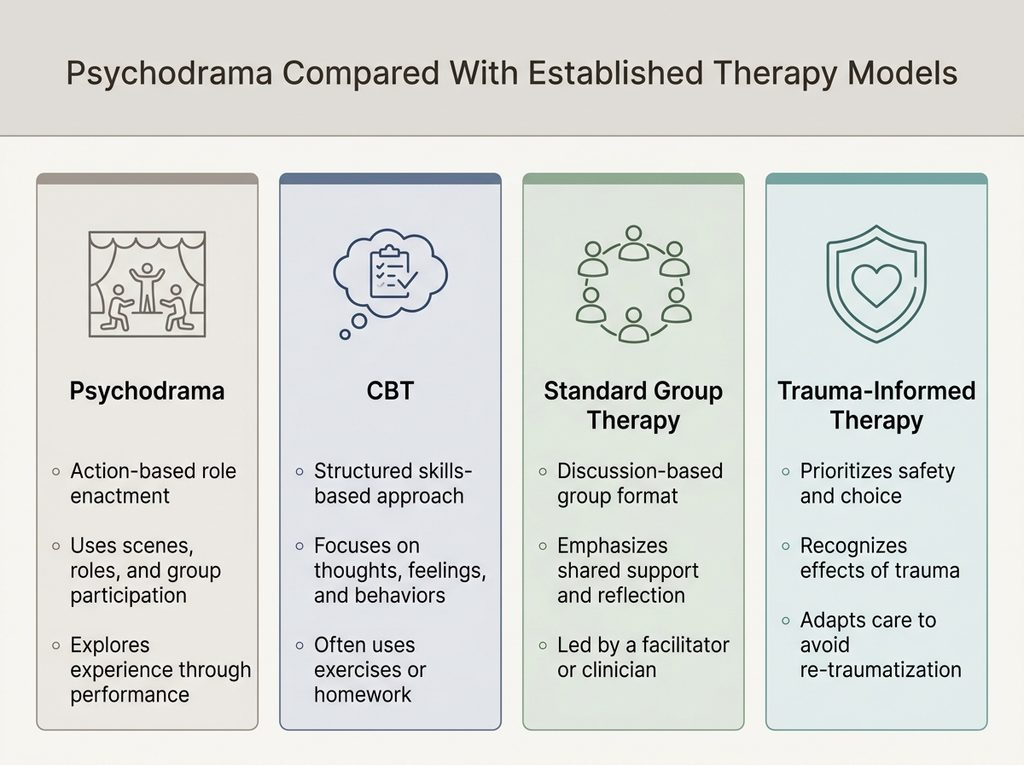
Psychodrama is easiest to understand when compared with better-known treatment models.
Cognitive behavioral therapy is a structured, evidence-based therapy that focuses on relationships among thoughts, emotions, behaviors, and physical responses. CBT often includes skills practice, cognitive restructuring, exposure strategies, behavioral activation, or homework between sessions.
Psychodrama is generally less focused on cognitive restructuring as a central mechanism. It works through enactment, role experimentation, emotional expression, and interpersonal feedback. Some psychodrama sessions may include behavioral rehearsal, which can overlap with CBT-style skills practice, but the theoretical frame and session structure are different.
For conditions where CBT has strong evidence, psychodrama should usually be considered complementary or exploratory rather than a direct substitute unless a qualified clinician has a clear rationale.
Standard group psychotherapy may focus on discussion, mutual support, interpersonal process, psychoeducation, or skills training. Psychodrama is also often group-based, but it adds a more active theatrical structure. Members may participate in scenes, play roles, or witness enactments.
This can create emotional immediacy and group connection. It can also increase intensity. That is why screening, consent, confidentiality, and skilled facilitation are especially important.
Trauma-informed therapy is not a single technique. It is an approach to care that emphasizes safety, choice, collaboration, empowerment, and awareness of how trauma affects the nervous system, relationships, and behavior.
Psychodrama can be delivered in a trauma-informed way, but it is not automatically trauma-informed simply because it helps people express emotion. Enacting painful experiences may be destabilizing if done too quickly or without adequate grounding, consent, and containment.
For PTSD or complex trauma, psychodrama should not be presented as a replacement for trauma-focused treatments with stronger guideline support. If used, it may be safer as an adjunct within a broader treatment plan led by a clinician trained in trauma care.
The appeal of psychodrama is understandable. Some people struggle to access emotions through conversation alone. Others understand themselves more clearly when they can physically map a relationship, speak from another role, or rehearse a new response.
Potential benefits may include greater emotional awareness, increased perspective-taking, improved interpersonal insight, and opportunities to practice new behaviors. In group settings, participants may also feel less alone when others recognize similar themes in their own lives.
These potential benefits are plausible and consistent with how psychodrama is designed to work. The evidence, however, does not justify broad claims that psychodrama reliably treats specific disorders on its own.
Psychodrama can be emotionally intense. That intensity is not inherently harmful, but it does raise safety considerations.
Possible risks include emotional flooding, shame, boundary confusion, feeling exposed in a group, reactivation of traumatic memories, or difficulty returning to stability after a session. Group formats also require careful confidentiality practices, since participants may witness sensitive personal material.
Psychodrama may not be a good fit as a primary intervention for someone who is currently experiencing acute psychosis, mania, severe dissociation, active suicidal crisis, uncontrolled substance use, or severe trauma symptoms without adequate stabilization. It may also be inappropriate for people who feel strongly coerced into participation or who are not comfortable with role-play and group witnessing.
This does not mean these individuals can never benefit from experiential or group-based work. It means the timing, setting, clinician qualifications, and treatment plan matter.
Because psychodrama can involve vulnerable emotional material, practitioner qualifications are central. A careful screening process is a sign of responsible practice, not a barrier to care.
When evaluating a practitioner or program, consider asking:
– Is the facilitator a licensed mental health professional, or are they working under appropriate clinical supervision?
– What formal training do they have in psychodrama therapy?
– Do they have experience with the specific concern being addressed, such as trauma, grief, anxiety, or substance use?
– How do they screen participants for group readiness?
– How do they handle informed consent, confidentiality, and emotional safety?
– What happens if someone becomes overwhelmed during or after a session?
– Is psychodrama being used as a standalone treatment or as part of a broader care plan?
– How do they coordinate with other providers when needed?
For clinical concerns, it is reasonable to prioritize practitioners who can explain both the potential value and the limits of psychodrama. Overconfident claims are a warning sign.
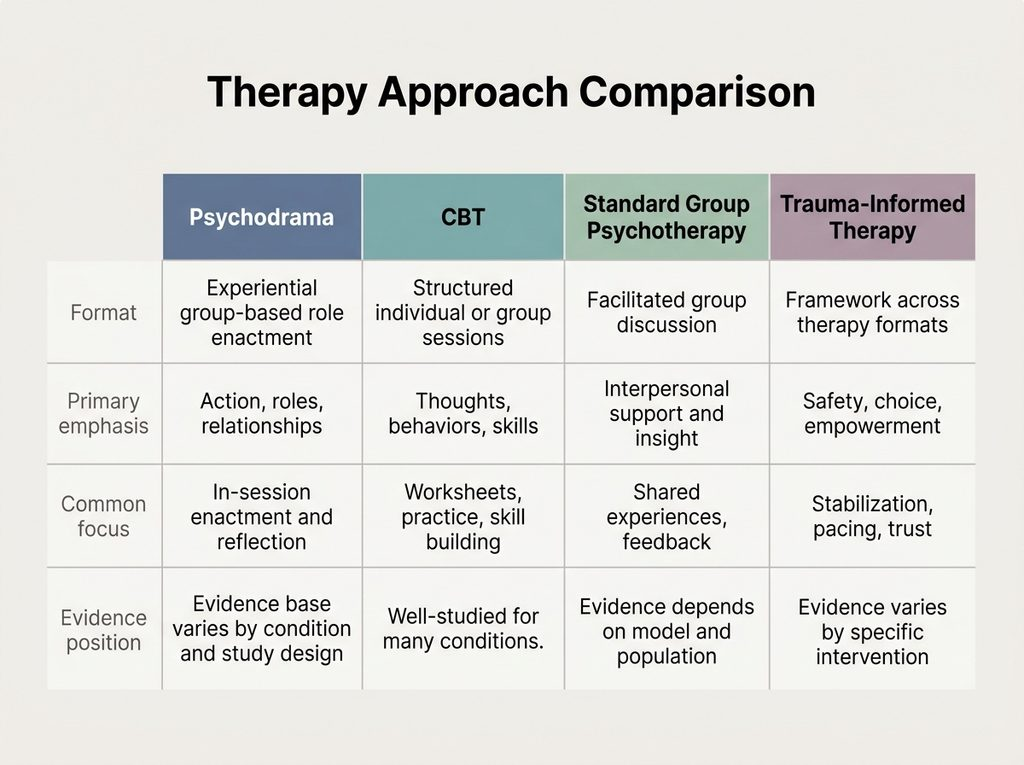
Psychodrama therapy is a distinctive form of experiential psychotherapy that uses enactment, role-play, sociometry, mirroring, doubling, role reversal, and group sharing to explore psychological and interpersonal themes. It is more than theater, but its theater-based methods are central to how it works.
The evidence base is promising in some respects but limited. Systematic reviews and meta-analyses suggest psychodrama may help some people in some contexts, yet the research is constrained by small samples, varied methods, heterogeneous populations, and inconsistent follow-up. It should not be framed as a proven standalone treatment for major mental health conditions.
For researchers, psychodrama remains an area where more rigorous trials, clearer treatment manuals, better comparison groups, and longer follow-up would strengthen conclusions. For therapy seekers, the safest interpretation is practical and balanced: psychodrama may be worth learning about or considering as a complementary approach, especially for interpersonal and emotional exploration, but serious symptoms should be evaluated with a qualified mental health professional who can recommend evidence-based therapy options.
To learn more, compare psychodrama with established treatments, ask about practitioner training, and look for clinicians who can discuss both the potential benefits and the current limits of the evidence.