



Newsletter Subscribe
Enter your email address below and subscribe to our newsletter

Ideas Worth Building

A hostile takeover is a formal M&A term for an acquisition attempt made without the target board’s approval. A “murderous takeover” is usually informal, dramatic language rather than a standard finance category.
If you are trying to understand merger and acquisition language, the phrase hostile takeover has a specific business meaning. The phrase murderous takeover usually does not.
That distinction matters. In corporate finance, precise wording can separate a recognized takeover process from dramatic commentary, fictional language, or an informal description of aggressive behavior. A hostile takeover is a formal M&A term tied to corporate control, board resistance, shareholder rights, and the takeover process. A “murderous takeover” is usually metaphorical language, not a standard legal or finance category.
Here is the practical difference.
A hostile takeover is an acquisition attempt made without the approval or cooperation of the target company’s board of directors. The bidder may try to buy shares directly from shareholders, replace board members, or otherwise bypass management to gain control.
A “murderous takeover” is not typically recognized as a formal merger and acquisition term. When people use it, they are usually describing a takeover they see as especially ruthless, destructive, predatory, or damaging. The phrase may appear in media commentary, fiction, political rhetoric, or casual business discussion, but it should not be treated as a standard M&A classification without more context.
In M&A terminology, a hostile takeover is defined by process and consent. The key point is that the acquiring company is trying to take control of a target company without support from the target company’s board.
That does not necessarily mean the offer is illegal, violent, or improper. “Hostile” refers to the position of the target company’s leadership, not to physical hostility. The board of directors may believe the offer undervalues the company, threatens its long-term strategy, harms employees or stakeholders, or is not in shareholders’ best interests.
A hostile takeover can still be presented as beneficial by the bidder. The acquiring company may argue that shareholders should accept the offer because it provides a premium, better management, or stronger strategic direction. The target company’s board may disagree and recommend that shareholders reject the attempt.
That tension is what makes the takeover hostile.
“Murderous takeover” is best understood as informal or figurative language unless a specific source defines it differently.
Someone might use the phrase to describe:
– An acquisition that leads to severe layoffs, asset sales, or restructuring
– A bitter corporate control battle between rival executives, investors, or factions
– A takeover strategy viewed as unusually aggressive or destructive
– A fictional or dramatized corporate power struggle
– A metaphor for wiping out a company’s culture, independence, or leadership
The word “murderous” is emotional and descriptive. It does not, by itself, tell you what legal mechanism was used, whether shareholders approved the deal, whether the board resisted, or whether the transaction was hostile in the formal M&A sense.
If you encounter the phrase, ask: is the writer using it as a technical term, or as dramatic shorthand?
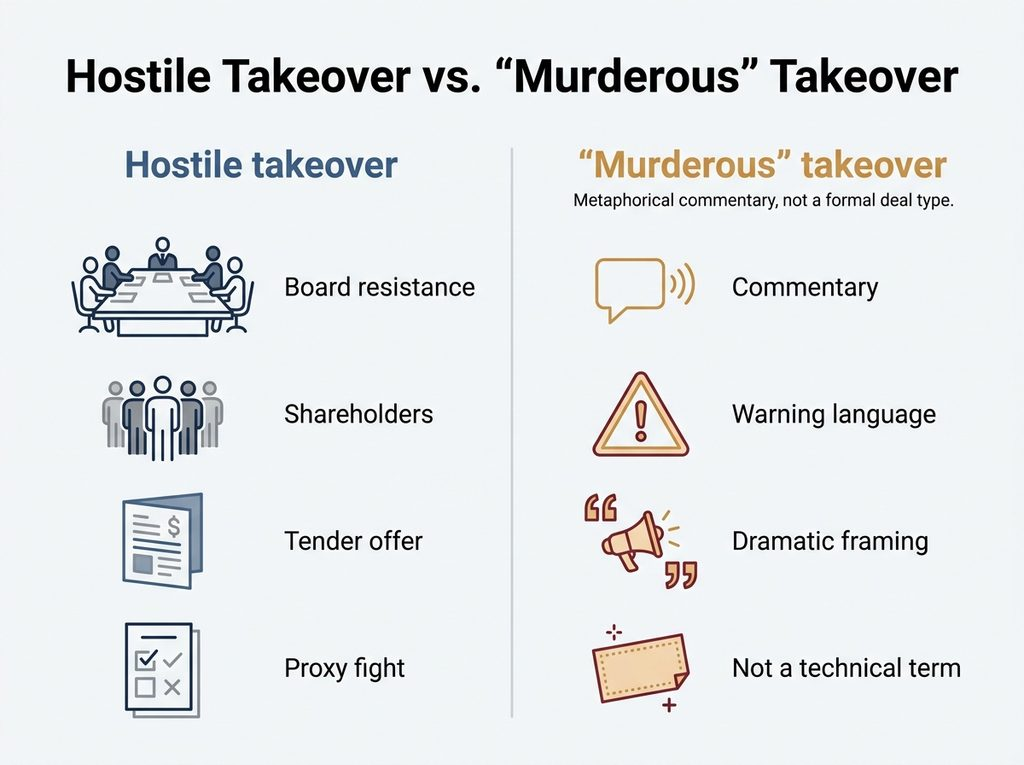
A hostile takeover usually centers on control of the target company. If the board of directors will not support the deal, the bidder may try to reach shareholders directly or change the composition of the board.
Common hostile takeover tactics include the following.
In a tender offer, the acquiring party offers to buy shares from the target company’s shareholders, often at a specified price. The bidder is effectively saying: sell your shares to us directly, even if the company’s board does not recommend the transaction.
Tender offers can be important because shareholders, not just directors, have economic interests in the company. If enough shareholders accept, the bidder may gain a controlling stake.
A proxy fight is an effort to persuade shareholders to vote in a way that changes corporate control. In a hostile takeover context, the bidder or activist investors may try to replace existing board members with directors who are more open to the acquisition.
This makes the board of directors central to the takeover process. If the bidder cannot get the current board to approve a deal, it may try to convince shareholders to elect a different board.
A bidder may also make a public case to shareholders. That case might argue that management is underperforming, the company’s strategy is weak, or the proposed merger and acquisition would create more value.
The target company’s leadership may respond with its own argument, warning shareholders that the bid is too low, too risky, or not aligned with the company’s future.
The board of directors has a responsibility to evaluate major corporate actions, including takeover proposals. In a friendly acquisition, the target company’s board generally agrees to the deal and recommends it to shareholders, depending on the transaction structure.
In a hostile takeover, that approval is absent. The acquiring party is not necessarily avoiding shareholders; in many cases, it is relying on them. But it is trying to overcome board resistance.
This is why the phrase hostile takeover is more precise than “aggressive takeover.” A takeover can be aggressive and still friendly if the board supports it. A takeover can be hostile even if the bidder’s public messaging is polite, as long as the target board opposes it and the bidder moves forward anyway.
Informally, yes. Technically, not as a separate standard category.
A commentator might call a hostile takeover “murderous” if they believe the acquiring company plans to dismantle the target company, cut jobs, sell assets, remove leadership, or eliminate a competitor’s identity. But that description is a judgment about tone or outcome, not a replacement for the formal term.
For example:
– “Hostile takeover” tells you about the acquisition process.
– “Murderous takeover” tells you about the speaker’s interpretation of the takeover’s severity or consequences.
Those are different kinds of information.
When you encounter “murderous takeover” in an article, book, video, or conversation, do not assume it has a fixed technical meaning. Instead, look for context.
Ask:
1. Is the target company’s board resisting the deal?
2. Is there a tender offer, proxy fight, or shareholder campaign?
3. Is the writer describing actual M&A mechanics or using colorful language?
4. Are the alleged harms specific, such as layoffs or asset sales, or merely implied?
5. Is the phrase appearing in fiction, opinion, or informal commentary?
If the answer involves board resistance and direct shareholder pressure, the formal term may be hostile takeover. If the answer is mostly about drama, ruthlessness, or destruction, “murderous” is likely rhetorical.
The difference is simple: a hostile takeover is a recognized M&A term; a “murderous takeover” is usually a dramatic description.
For entrepreneurs, investors, students, and business readers, the safest approach is to use hostile takeover when discussing the formal process of acquiring a target company without board approval. Use caution with “murderous takeover,” because it may communicate intensity but not technical accuracy.
When in doubt, separate the mechanics from the metaphor. That will help you understand who is trying to gain corporate control, how they are doing it, and whether the language being used is legal, financial, or simply dramatic.
Learn more about M&A terminology, corporate governance, and how takeover processes work before relying on informal labels.