

Newsletter Subscribe
Enter your email address below and subscribe to our newsletter

Ideas Worth Building

Animal studies suggest a Salvia-associated psychedelic compound may influence pain, addiction, and stroke-related biology. But anxiety-like side effects and the preclinical nature of the evidence remain major caveats.
A psychedelic compound associated with *Salvia divinorum* is drawing attention in neuroscience because animal studies suggest it may influence biological pathways relevant to pain, addiction, and stroke recovery. That combination makes the research scientifically intriguing — but also easy to overstate.
The central point is simple: this is not evidence that *Salvia divinorum* is a pain treatment, an addiction therapy, or a stroke-recovery aid for people. The findings are preclinical, meaning they come from animal models rather than human clinical trials. They are best understood as an early signal that a highly unusual psychoactive system may be worth studying more carefully.
That distinction matters. The same research that makes the compound interesting also highlights a major problem: anxiety-like or aversive side effects that could limit its medical usefulness.
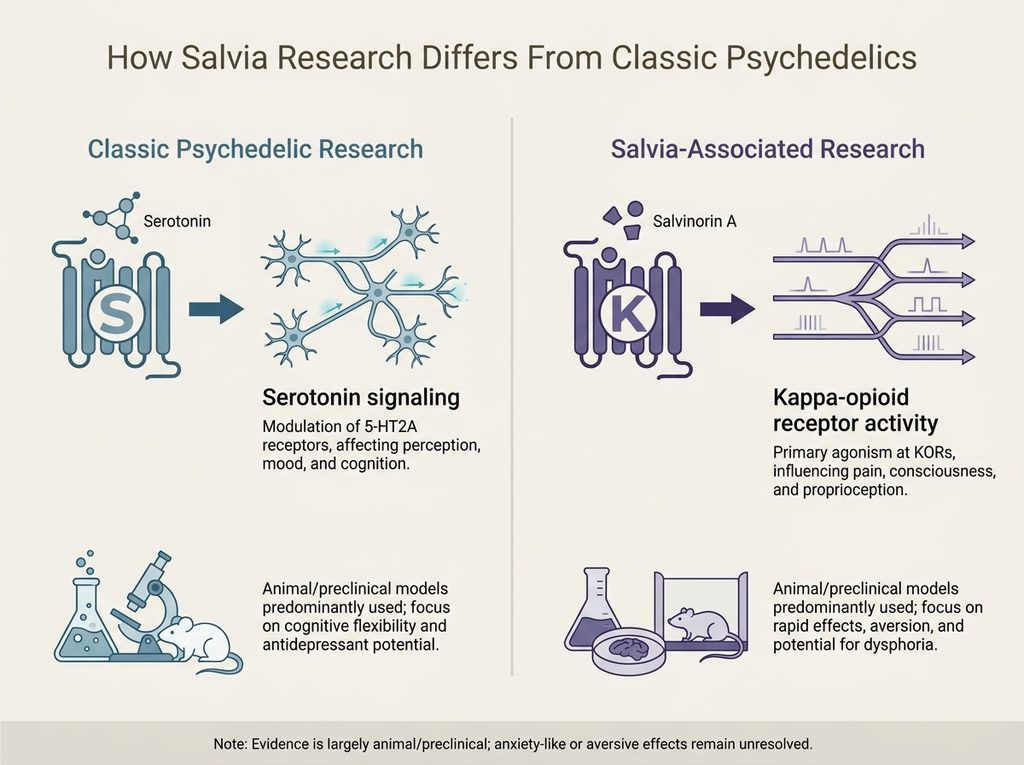
Most public discussion of psychedelic medicine focuses on classic psychedelics such as psilocybin or LSD, which are commonly discussed in relation to serotonin signaling. *Salvia divinorum* sits in a different category.
The plant is best known scientifically for salvinorin A research. Salvinorin A and related compounds are unusual because they are associated with kappa-opioid receptor activity, a system involved in pain, stress, mood, reward, and perception. That makes this area of psychedelic neuroscience distinct from the better-known serotonin-centered psychedelic field.
This difference is one reason scientists are interested. If a Salvia-derived compound can affect pain-related behavior, drug-seeking behavior, or post-stroke outcomes in animals, it may point to drug targets that are not addressed by classic psychedelic research.
But “different” does not automatically mean “better.” Kappa-opioid receptor activity has long been scientifically complicated because it may intersect with both analgesic effects and unpleasant psychological effects. That tension appears to be central to the current findings.
According to the reported research, scientists tested an unusual Salvia-associated psychedelic compound in animal models relevant to several medical areas:
– Pain treatment research
– Addiction-related behavior
– Stroke recovery animal studies
The reported results suggest potential benefits across these experimental models. In plain language, the compound appeared to influence animal behaviors or outcomes that researchers use as early indicators of whether a drug candidate might be worth further investigation.
For pain, that could mean changes in responses to painful stimuli in animal testing. For addiction treatment research, it could involve effects on reward- or drug-related behaviors. For stroke research, it could involve recovery-related measures after experimental injury.
Those findings are enough to make the compound scientifically notable. They are not enough to establish medical value in humans.
Animal models are an important first step in biomedical research, but they are not a guarantee that a treatment will work safely in people. Many compounds that look promising in preclinical studies fail later because the effect is too small, the dose is impractical, the biology does not translate, or the side effects are unacceptable.
That is especially important for any discussion of Salvia divinorum pain treatment. The current evidence supports research interest — not self-treatment, clinical use, or medical recommendation.
The most important caution in the research is not a minor footnote. The compound’s potential benefits appear to come with anxiety-like or aversive side effects in animal models.
In drug development, aversive effects matter because a compound can look useful in one test while still being poorly tolerated overall. A medicine for pain, addiction, or neurological recovery would need to do more than affect a target pathway. It would also need to be safe, tolerable, controllable, and appropriate for repeated or medically supervised use.
This is where the Salvia-related field faces a difficult question: can researchers separate potentially useful biological effects from unpleasant psychoactive or anxiety-producing effects?
That question is not settled. It is one of the main reasons the research should be interpreted with caution rather than excitement alone.
*Salvia divinorum* is a powerful psychoactive plant with significant safety concerns. It should not be treated as a wellness supplement, a home remedy, or a practical substitute for medical care.
The distinction between therapeutic research and recreational use is especially important here. A controlled animal study of a specific compound does not mean that consuming a plant or using an unregulated product will reproduce the same effects. Dose, purity, route of administration, biological target, and medical monitoring all matter.
Legality and safety can also vary by location, and psychoactive substances can carry risks that are not captured by headlines about early-stage promise.
For this line of psychedelic pain research to become clinically meaningful, future studies would need to clarify several points:
1. Which compound is producing the observed effects, and through which receptor systems?
2. Are the benefits reproducible across different animal models and research teams?
3. Can researchers reduce anxiety-like or aversive effects while preserving any therapeutic signal?
4. What doses appear effective, and how close are they to doses that cause unacceptable side effects?
5. Do the findings translate beyond animals into carefully designed human safety studies?
Until those questions are answered, the most accurate conclusion is measured: Salvia-derived psychedelic compounds may offer a useful window into pain, addiction, and stroke biology, but they are nowhere near ready to be described as proven treatments.
For readers following emerging psychedelic neuroscience, the responsible next step is to read the research and watch how the evidence develops — without assuming that early animal findings equal a future medicine.