


Newsletter Subscribe
Enter your email address below and subscribe to our newsletter

Ideas Worth Building

Court filings reportedly claim Microsoft Copilot’s AI answers cut New York Times click-through rates by up to 93%, intensifying concerns about publisher traffic and AI search.
Court documents in The New York Times Company’s legal fight with Microsoft and OpenAI reportedly claim that Microsoft Copilot’s AI answers reduced New York Times click-through rates by as much as 93% for certain search-style interactions.
That figure is not an independently verified industry benchmark. It is an allegation from court filings, and the details behind the measurement still matter. But if the claim holds up under scrutiny, it points to one of the biggest unresolved questions in AI search: what happens to publisher traffic when answer engines give users what they came for without sending them back to the original source?
For media companies, startups, creators, and anyone who depends on the open web, the issue is larger than one publisher or one product. It is about whether generative AI systems can summarize the internet while weakening the traffic loops that help fund the internet’s original reporting.
The central claim is striking: Microsoft Copilot’s AI answer engine allegedly caused New York Times click-through rates to fall by up to 93% in the context described in court documents.
Click-through rate measures how often people click from a search result, answer box, or digital surface to the underlying website. A 93% drop, if representative, would mean far fewer readers reaching the publisher after seeing an AI-generated answer.
The claim appears in the broader legal dispute involving The New York Times, Microsoft, and OpenAI. The Times has argued that generative AI companies used its journalism in ways that harmed the publisher’s business and violated its rights. Microsoft and OpenAI have contested the claims in that litigation.
The important caveat: the reported Microsoft Copilot click-through rate decline should be treated as a court-document claim, not a final factual finding. Court filings are advocacy documents. They can include evidence, expert analysis, internal communications, and legal arguments, but the claims still need to be tested through the legal process.
On the surface, a click-through decline sounds like a technical search metric. In reality, it connects directly to publisher revenue and bargaining power.
Publishers depend on referral traffic for several business functions:
– attracting new readers who may become subscribers;
– serving ads to visitors;
– building audience relationships;
– demonstrating reach to advertisers and partners;
– strengthening their position in licensing negotiations;
– proving that their reporting has public value and market demand.
If AI search tools answer a user’s question directly, the user may not need to click. That can be useful for consumers in the moment. But for publishers, it may mean their work helped generate the answer while the visit, ad impression, subscription prompt, or brand relationship never arrives.
That is why the New York Times example is being watched closely. A major publisher can fight in court and negotiate licensing deals. Smaller publishers, niche blogs, local newsrooms, independent researchers, and solo creators often cannot.
An AI answer engine is a system that responds to a query with a synthesized answer instead of only presenting a list of links. Microsoft Copilot, Google’s AI search features, Perplexity-style tools, and other generative AI search products fit into this broader shift.
Traditional search was built around discovery. A user searched, scanned results, clicked a link, and visited a publisher’s page. The publisher got traffic. The search engine got user engagement. The web page remained the destination.
AI search changes that flow. The answer itself becomes the destination.
That is convenient when a user wants a quick summary. But it also means that the publisher’s role can shift from destination to raw material. The user may see a concise answer generated from or influenced by reporting, reviews, analysis, or databases without visiting the site that produced the underlying work.
This is the core economic tension behind the current wave of publisher disputes with generative AI companies.
The New York Times case sits inside a larger conflict over how AI companies collect and use online content.
Publishers have raised concerns that generative AI systems were trained on copyrighted material without permission or adequate compensation. AI companies and their partners have argued, in various contexts, that their systems operate lawfully and that AI-generated tools provide new ways for users to access information.
The click-through issue adds another layer. The dispute is not only about whether AI models were trained on publisher content. It is also about whether AI products may substitute for visiting publisher sites.
That substitution risk is what makes the alleged 93% figure so powerful. If an AI answer engine gives users enough information to satisfy the query, the publisher may lose the visit even when its work helped inform the answer.
This is also where the phrase “labor theft” enters the debate. Critics argue that AI systems can extract value from human-created reporting, writing, editing, photography, research, and analysis without returning enough traffic or money to the people and organizations that created it. Supporters of AI tools may counter that search engines have always indexed and summarized the web, and that new products can create different forms of discovery.
The courts may not resolve every economic question. But the filings are forcing a public examination of how value moves through AI search.
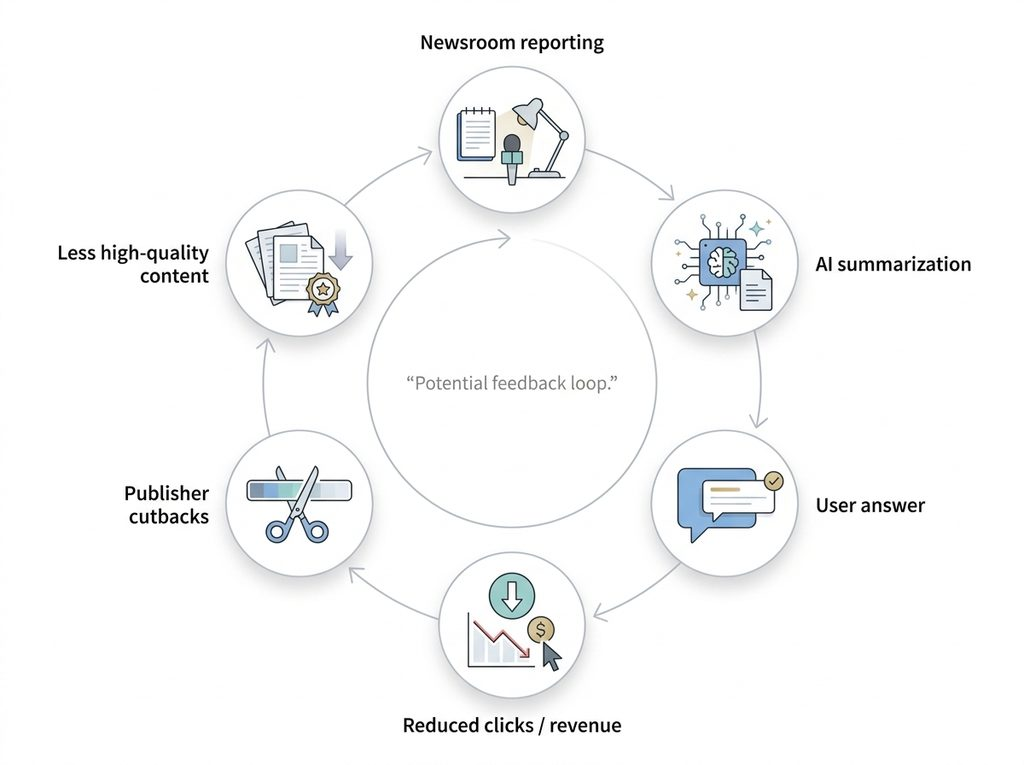
The deepest concern is a web traffic doom loop.
The loop would look something like this:
1. Publishers invest in original reporting and useful content.
2. AI systems summarize that content in answer products.
3. Users get answers without clicking through.
4. Publisher traffic and revenue decline.
5. Publishers cut back on reporting and content production.
6. AI systems have less high-quality new material to summarize.
That outcome is not guaranteed. AI companies may strike licensing deals, improve citation design, send meaningful referral traffic, or develop revenue-sharing models. Publishers may adapt with stronger direct audiences, newsletters, memberships, apps, and paywalled products.
Still, the fear is straightforward: if answer-based discovery weakens the incentives to publish original work, the web becomes less useful for everyone, including the AI systems that depend on it.
The 93% number is attention-grabbing, but several key questions remain unanswered from the available public reporting and court-document framing.
First, the methodology matters. It is not yet clear from the available material how the click-through rate was measured, over what time period, or against what baseline.
Second, sample size matters. A dramatic decline across a small number of query types would mean something different from a broad decline across many topics and user behaviors.
Third, query intent matters. AI answers may reduce clicks more sharply for simple factual questions than for investigative reporting, opinion, product comparisons, recipes, local news, or subscription-driven analysis.
Fourth, attribution and interface design matter. Some AI answer products may provide prominent source links. Others may make citations less visible or less likely to be clicked. Small design choices can have large effects on publisher traffic.
Finally, the figure does not prove that every publisher will experience the same decline. The New York Times has a distinctive brand, audience, subscription model, and legal position. Other publishers may see different outcomes.
The Microsoft Copilot click-through rate claim is important because it puts a number on a fear publishers have been discussing for years: AI search may not simply reorganize web traffic. It may reduce the need for it.
For consumers, AI answers can be fast and useful. For publishers, they may be financially dangerous if the systems absorb the value of journalism while sending back fewer readers. For AI companies, the challenge is proving that answer engines can coexist with the web rather than hollow it out.
The court case will continue to test legal questions around copyright and AI. But the business question is already here: if the internet moves from links to answers, who gets paid for the work behind the answer?
Read more as the filings and responses develop, because the outcome could shape the future of AI search, publisher traffic, and the economics of online content.