

Newsletter Subscribe
Enter your email address below and subscribe to our newsletter

Ideas Worth Building
OpenAI’s warning about AI swarm attacks signals a shift in cyber risk: faster, more coordinated, AI-enabled campaigns. Here’s what business owners need to understand and how to prepare without panic.
OpenAI’s warning about AI-enabled swarm cyberattacks should land differently for business owners than another routine cybersecurity headline.
This is not a prediction that machines are about to become unstoppable attackers. It is a warning that the economics of cybercrime may be changing fast. If attackers can use coordinated AI agents to research targets, write convincing messages, test vulnerabilities, automate credential attacks, and adapt in real time, then the number of businesses exposed to sophisticated campaigns could expand dramatically.
As reported by ZDNET, OpenAI has warned that sophisticated AI swarm attacks may be months away. The exact timeline will be debated. What matters for executives, founders, and IT leaders is the direction of travel: AI cyberattacks are moving from simple prompt-assisted scams toward more automated, coordinated, and scalable operations.
For most companies, especially small and mid-sized businesses, the practical question is not whether this sounds futuristic. It is whether their current cybersecurity posture can handle attackers that move faster, personalize better, and operate at greater scale than traditional criminal groups.
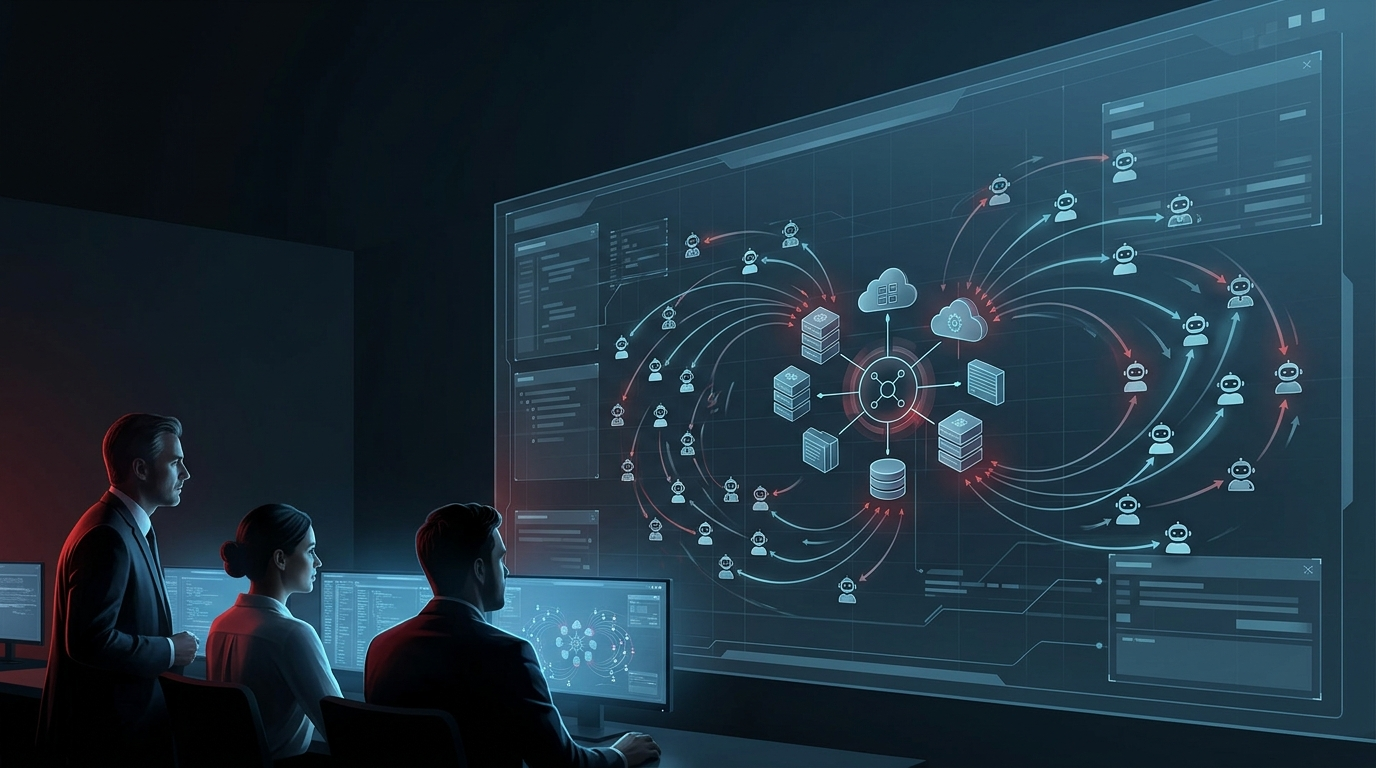
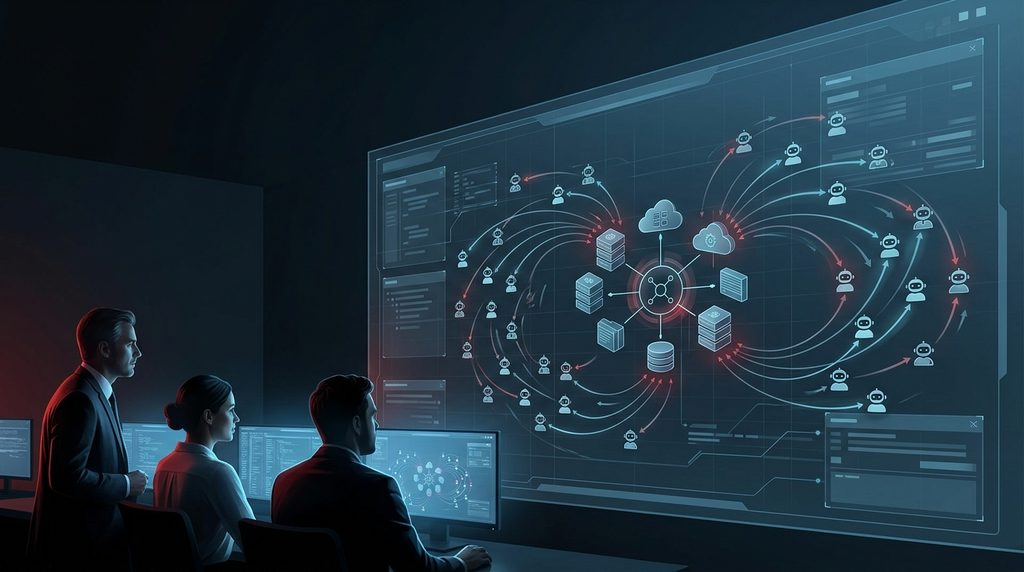
AI swarm attacks are coordinated cyber campaigns in which multiple AI-driven systems, tools, or agents work together toward a malicious goal.
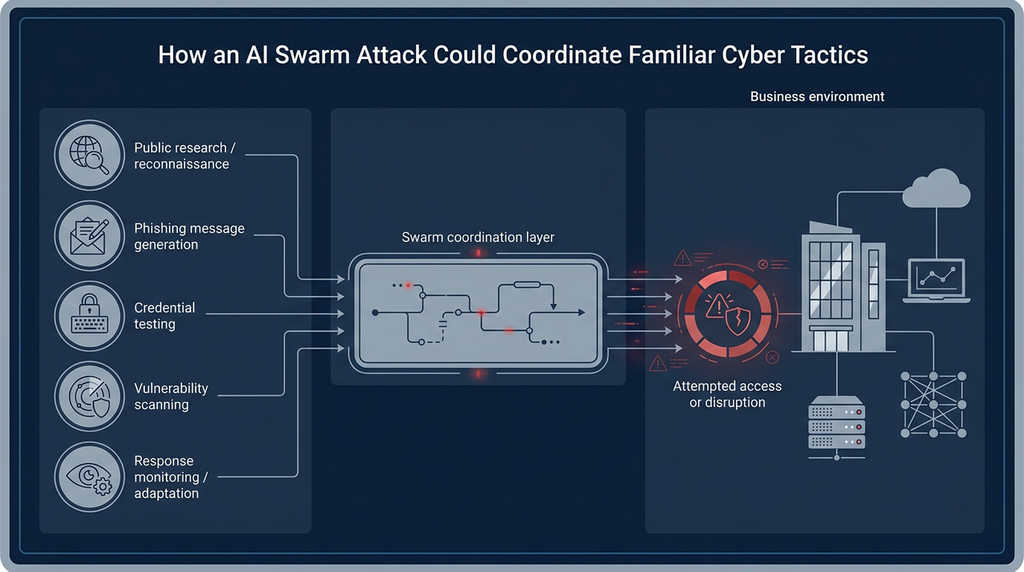
In plain language, imagine a group of automated assistants assigned different jobs:
– One scans public information about a company.
– One identifies executives, vendors, employees, and exposed systems.
– One drafts tailored phishing messages.
– One tests stolen passwords or leaked credentials.
– One looks for known software vulnerabilities.
– One monitors responses and adjusts the next step.
That is the core idea behind AI swarm attacks. The danger is not one magic bot doing everything perfectly. The danger is coordination.
Traditional cyberattacks already use automation. Criminals already run phishing kits, botnets, credential-stuffing tools, vulnerability scanners, and malware infrastructure. AI agents cybersecurity concerns build on that existing foundation. The difference is that AI can make parts of the process more flexible, more targeted, and less dependent on human labor.
A human attacker might research one target carefully. A coordinated AI system could potentially research many. A criminal team might write a handful of convincing emails. AI phishing attacks could generate variations for different roles, industries, and languages. A conventional script might fail when conditions change. An AI-assisted workflow could be designed to adjust its tactics based on what it sees.
That is why an OpenAI cybersecurity warning deserves attention from business leaders, not only technical teams.
The near-term risk is not science fiction. It is acceleration.
Businesses already face phishing, ransomware, business email compromise, vendor impersonation, stolen credentials, and automated probing of internet-facing systems. AI does not need to invent new categories of crime to become dangerous. It only needs to make existing attacks cheaper, faster, and more convincing.
A coordinated AI attack could compress what used to take days of manual effort into hours or minutes. It could help attackers run more experiments, produce more believable content, and identify weak points across many organizations at once.
For business owners, the concern is simple: attackers may be able to scale faster than defenders.
Large enterprises have security operations centers, threat intelligence teams, dedicated incident responders, and layered monitoring. Many small businesses have one IT generalist, an outsourced provider, or no formal cybersecurity staff at all. That gap already exists. Automated cyber threats could widen it.
It is important to separate credible near-term risks from dramatic speculation. There is no need to imagine fully autonomous digital armies taking over the internet to understand the business threat.
The realistic concern is that AI systems could coordinate several familiar attack steps more efficiently.
AI-generated phishing is already a concern because it can produce polished, context-aware messages. In a swarm model, one agent could gather details from websites, social media, job postings, press releases, and public documents. Another could turn that information into emails that reference real projects, vendors, executives, or deadlines.
For a business, that means the old advice to look for bad grammar and obvious typos is no longer enough. AI phishing attacks can look professional. They can also be customized to different employees, making them harder to spot.
Attackers often begin by mapping a company’s digital footprint. They look for domains, cloud services, exposed login portals, outdated systems, employee names, vendors, and technology clues.
AI agents could help automate that discovery process. A coordinated system might identify which companies use a particular software product, which employees have finance responsibilities, or which suppliers are likely to be trusted by the target.
That does not guarantee a breach. But it gives attackers a better starting point.
Many intrusions begin with known vulnerabilities that organizations have not patched. AI-assisted tools could help attackers prioritize targets, interpret technical information, and test for weaknesses across many systems.
The credible risk is not that AI instantly discovers every unknown flaw. The more immediate issue is that attackers may become better at finding and exploiting the ordinary gaps businesses leave behind: unpatched software, exposed services, weak configurations, and forgotten accounts.
Stolen passwords remain one of the most common paths into business systems. Coordinated AI attacks could assist with sorting credential dumps, matching users to companies, generating likely username formats, and testing access across multiple services.
If a company still relies on passwords alone, it is creating an easy opening. Multi-factor authentication is not perfect, but it can significantly reduce the damage from stolen credentials when implemented well.
AI-generated text, audio, images, and video also raise concerns around impersonation. A coordinated campaign could target employees, customers, suppliers, or the public with misleading messages that appear to come from a trusted source.
For businesses, this could show up as fake invoices, executive impersonation, fraudulent payment instructions, bogus customer support messages, or reputational attacks. The more convincing the content, the more important verification processes become.
A sober analysis matters because fear can lead to bad decisions.
AI swarm attacks should not be treated as invincible, self-directed superintelligence. Attackers still need infrastructure, objectives, access points, and a way to convert technical activity into business damage. AI systems make mistakes. They can generate false leads. They can be blocked, monitored, rate-limited, and disrupted.
Defenders also have AI-enabled tools. Security vendors are using machine learning and automation for detection, alert triage, fraud monitoring, and incident response. Government and industry cybersecurity authorities, including organizations such as CISA and NIST, continue to emphasize proven security fundamentals because those basics still matter.
The right conclusion is not panic. It is readiness.
Small and mid-sized businesses often assume they are too small to be targeted. AI-driven automation makes that assumption more dangerous.
Attackers do not need to care about a company personally if they can scan thousands of businesses for weak controls. A smaller firm may become attractive because it has weaker defenses, valuable data, payment workflows, or access to larger customers.
Many smaller organizations also have practical constraints:
– Limited security budgets
– Few dedicated IT staff
– Heavy reliance on vendors and cloud tools
– Inconsistent employee training
– Informal approval processes for payments and account changes
– Backups that are not regularly tested
– Little experience running incident response exercises
That combination makes business cybersecurity preparedness a leadership issue, not just an IT issue.
If AI cyberattacks become more coordinated, the companies most at risk may not be the most famous. They may be the ones with the least visibility into their own systems.
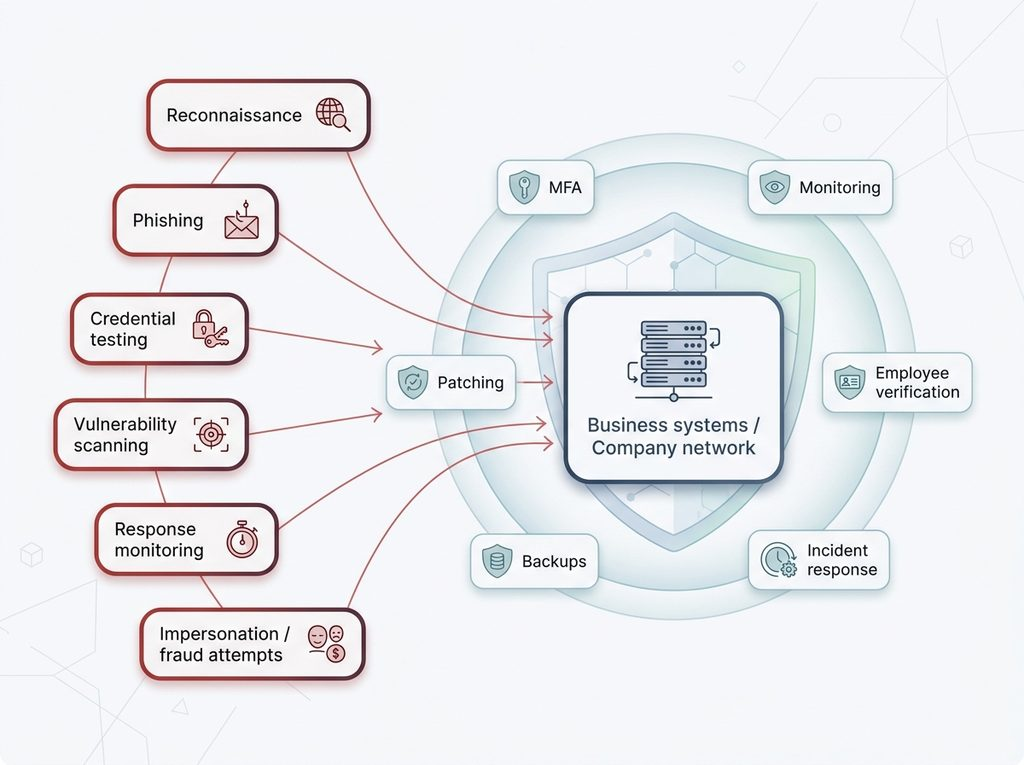
Preparation does not require chasing every new security product. It starts with reducing the obvious opportunities that automated attackers exploit.
Every business should know what happens if an account is compromised, a ransomware note appears, a vendor email is spoofed, or customer data may be exposed.
An incident response plan should define who makes decisions, who contacts legal counsel, who talks to customers, who works with insurers, who can shut down systems, and how the business communicates if normal email or chat tools are compromised.
A plan that lives in a forgotten document is not enough. It should be reviewed, updated, and practiced.
Employee training needs to evolve beyond spotting spelling mistakes. Staff should learn to verify unusual requests through a separate channel, especially when money, credentials, sensitive files, or account changes are involved.
Training should cover:
– Vendor impersonation
– Executive impersonation
– Fake invoices
– Password reset scams
– Urgent payment requests
– Suspicious file-sharing links
– Unexpected MFA prompts
The goal is not to make every employee a cybersecurity expert. It is to create a culture where verification is normal.
MFA should be enabled for email, financial systems, cloud platforms, administrator accounts, remote access, customer databases, and any system that holds sensitive information.
Businesses should also review how MFA is configured. Stronger methods are preferable where feasible, especially for privileged users. Attackers will continue looking for ways around weak authentication, but password-only access is no longer defensible for important systems.
AI swarm attacks could generate more activity across more channels. Businesses need enough visibility to notice abnormal behavior.
At minimum, companies should monitor suspicious logins, impossible travel alerts, new administrator accounts, unusual data transfers, repeated failed login attempts, and changes to security settings.
For small businesses, this may mean working with a managed service provider or security partner. The important point is that someone must be responsible for watching the signals.
Automated attackers thrive on known weaknesses. Businesses should keep operating systems, browsers, cloud services, plugins, firewalls, VPNs, and business software updated.
This is not glamorous work, but it is one of the most practical defenses against automated cyber threats. Leaders should ask how quickly critical patches are applied and whether any internet-facing systems are overdue.
Coordinated AI attacks may target vendors, service providers, and business partners as indirect paths into a company. That makes vendor risk reviews more important.
Businesses should know which vendors have access to systems, data, payment workflows, or customer information. They should also ask about MFA, breach notification practices, access controls, and data handling.
Vendor trust should not be unlimited simply because the relationship is familiar.
Employees are already experimenting with AI tools. That can improve productivity, but it can also introduce risk if staff paste confidential data, customer records, credentials, source code, or contract details into external systems without approval.
An AI usage policy should explain what data can and cannot be used with AI tools, which tools are approved, who can authorize exceptions, and how outputs should be verified.
AI agents cybersecurity is not only about attackers. It is also about controlling how AI is used inside the business.
Backups are essential, but untested backups create false confidence. Businesses should maintain backups that are separated from normal production systems and periodically verify that restoration actually works.
If ransomware or destructive malware enters the picture, backup discipline can determine whether the business is disrupted for hours, days, or longer.
A tabletop exercise is a structured discussion of a realistic incident. It does not require expensive technology. It requires leadership attention.
A useful exercise might ask: What if the CEO’s email is compromised? What if payroll receives fraudulent payment instructions? What if a vendor portal is breached? What if customer data appears to be exposed?
These exercises reveal gaps before attackers do.
OpenAI’s warning should be read as an early signal, not a prophecy. The exact shape of AI swarm attacks will evolve. Some predictions may prove overstated. Others may arrive faster than expected.
But the strategic business implication is already clear: cybersecurity plans built for slower, more manual attackers may not be enough.
Business owners and executives should focus on the controls that reduce exposure regardless of how AI develops: strong authentication, employee verification habits, patching, monitoring, vendor oversight, incident response planning, AI usage rules, and reliable backups.
AI threat warning headlines will keep coming. The companies that respond best will not be the ones that panic. They will be the ones that turn uncertainty into preparation.
Read more on AI security developments, emerging cyber risks, and practical technology strategy as this threat landscape continues to change.