

Newsletter Subscribe
Enter your email address below and subscribe to our newsletter

Ideas Worth Building

Viral science claims can spread quickly through syndication and aggregation, but publishers need stronger verification before repeating extraordinary headlines. Here is a practical framework for protecting editorial trust.

Extraordinary science claims are built for the modern news feed. They are surprising, easy to summarize, emotionally sticky, and often framed in a way that makes readers feel they are discovering something hidden or remarkable.
That is exactly why publishers need to slow down before syndicating them.
A claim such as “an Asian tribe developed a new mutant gene allowing them to swim underwater for five hours a day” has the shape of a viral science story: human evolution, genetic mutation, an isolated community, and a superhuman-sounding ability. But that does not make it true. Without a clear original source, named researchers, peer-reviewed evidence, publication details, and context from credible science reporting, it should be treated as an unverified claim — not as a publishable fact.
For independent publishers, editors, and media operators, the issue is bigger than one questionable headline. Viral science claims can travel quickly through news aggregation, content syndication, social platforms, and feeds such as the MSN news platform and Microsoft Start. Once a weak claim is republished in enough places, repetition can start to look like verification.
That is a reputational trap.
Science stories often become distorted because they pass through several layers of simplification.
A peer-reviewed finding may begin with a narrow conclusion. A press release may make it more accessible. A general news article may make it more dramatic. A social post may remove the caveats entirely. By the time the claim reaches a headline optimized for clicks, the original science can be barely recognizable.
That is why editorial standards matter most when a claim sounds most shareable.
A newsroom should be especially cautious when a science claim includes:
– A dramatic biological ability that sounds superhuman
– Vague references to a “tribe,” “ancient people,” or “mutation” without specifics
– No named study, journal, institution, or researcher
– No publication date or traceable original reporting
– Repetition across low-context websites rather than independent confirmation
– A headline that presents a complex adaptation as a single miraculous gene
The underwater-swimming gene claim raises several of these flags. It may be loosely inspired by real research into diving populations, but the leap from adaptation research to “five hours underwater per day” requires careful scrutiny.
Publishers should not treat that leap as harmless exaggeration. In science reporting, exaggeration can become media misinformation.
There is a legitimate scientific context behind some stories about human diving ability. Researchers have studied physiological and genetic adaptations among sea nomad populations whose communities have long histories of free diving and marine subsistence.
That broad context, however, is not the same as proving a sensational headline.
Real research into human adaptation is usually precise. It may discuss population-level traits, evolutionary pressure, spleen size, oxygen use, diving response, or genetic associations. It does not automatically support claims that a group has a “new mutant gene” or that individuals can swim underwater for “five hours a day” in the way a casual reader might interpret.
Editors should ask: What exactly did the study find? What did it not find? Did the researchers make the headline claim, or did a later publisher add it?
That distinction is central to responsible science reporting.
Platforms such as MSN and Microsoft Start operate in a broader ecosystem of content syndication and news aggregation. For publishers, this can create major distribution opportunities. A story that might have reached a modest direct audience can gain visibility through platform feeds, recommendation systems, and republished placements.
But distribution scale also increases editorial risk.
If a weak science claim enters an aggregation environment, it can be separated from important context. Readers may see a headline, thumbnail, and excerpt without understanding the original source quality. If multiple sites republish similar versions, the claim may appear more established than it is.
This is where publisher trust becomes a business issue, not just an editorial principle.
A single sensational article may earn short-term attention. But repeated exposure to questionable claims can damage brand authority, reduce reader confidence, and make platforms more cautious about a publisher’s reliability. Publisher verification is therefore part of long-term audience development.
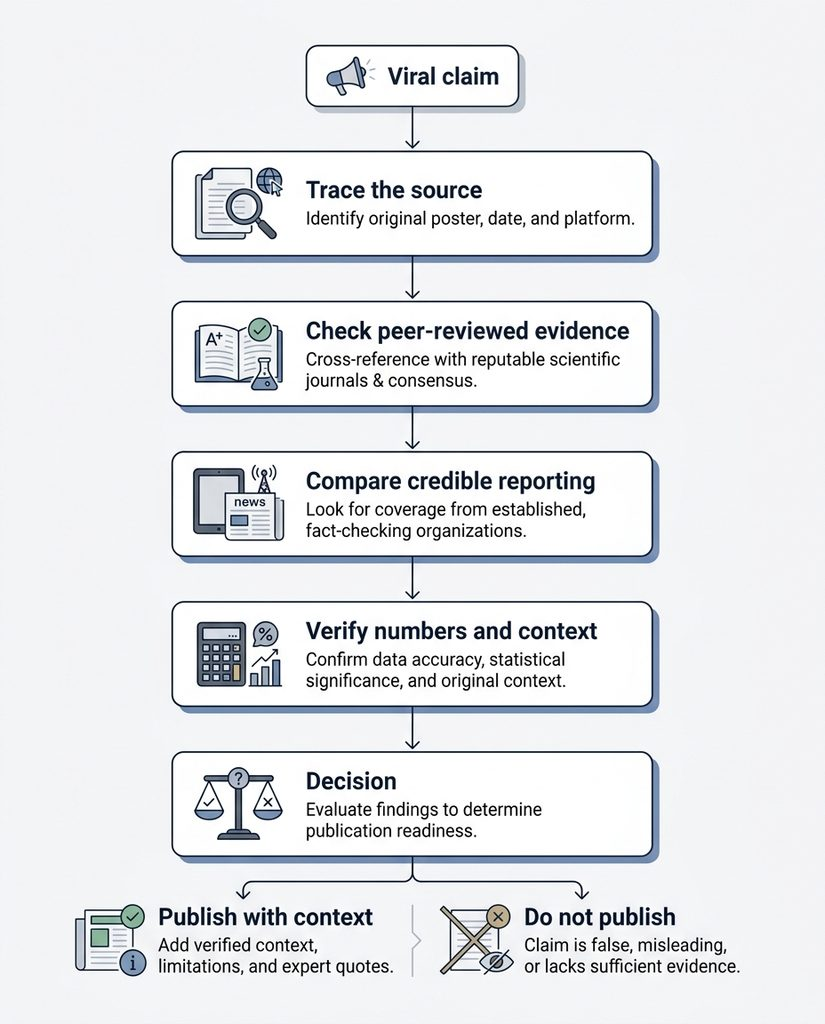
Before publishing or syndicating an extraordinary science claim, editors should move through a clear verification process.
Do not begin with the most viral version. Start by finding the earliest credible version of the claim.
Ask:
– Where did this claim first appear?
– Is there a named study, researcher, university, journal, or field site?
– Is the original source a peer-reviewed paper, a press release, a news article, or a social post?
– Has the claim changed as it moved from one outlet to another?
If the claim cannot be traced beyond reposts and summaries, it is not ready for publication as fact.
A peer-reviewed paper is not the same thing as a viral headline about that paper.
Editors should compare the claim against the original research language. If a study says a population shows a measurable adaptation associated with diving, that is different from saying a “mutant gene” allows people to remain underwater for hours.
This step is especially important for genetics coverage. Genes rarely work as simple on/off switches for complex human abilities. Headlines that imply one gene directly creates a dramatic trait should be treated with caution unless the source evidence is unusually strong and clearly explained.
A claim does not need to appear everywhere to be true. But if an extraordinary finding is real, there should usually be some trace of responsible coverage, expert discussion, or academic documentation.
Editors should look for coverage from credible science publications, university research pages, established newsrooms with science desks, or direct journal material. The goal is not to copy their framing, but to confirm whether the core claim has been responsibly reported.
If only low-context sites repeat the same dramatic wording, that is a warning sign.
The phrase “five hours underwater per day” sounds specific, but it may be misleading without context.
Does it mean five continuous hours? Multiple dives totaling five hours? Time spent in the water rather than submerged? A historical average? A modern observation? A claim from one individual or a studied population?
Numbers make headlines feel authoritative. Editors should verify what the number actually measures before using it.
If the story is worth covering but the viral claim is not fully supported, publishers can still produce a useful article. The angle should change from “this amazing thing is true” to “here is what the research does and does not show.”
That approach can be more valuable for readers and safer for the publisher.
Not every source deserves equal weight. A simple hierarchy can help editors make faster decisions.
At the top are peer-reviewed papers, official journal pages, named academic institutions, and direct interviews with qualified experts. Next are reputable science journalists and established outlets that cite primary evidence. Lower down are general aggregation pages, rewritten summaries, anonymous blogs, and social media posts.
News aggregation can help people discover stories, but it should not replace fact checking. The presence of a claim on a large platform does not automatically establish that the claim is accurate. It may only show that the claim was syndicated, indexed, or republished.
That difference matters for publisher verification.
Some publishers treat viral science claims as low-risk entertainment. That is a mistake.
Science misinformation can affect how readers understand health, genetics, culture, and entire communities. It can also reduce trust in legitimate research by mixing real scientific findings with exaggerated conclusions.
There is also a cultural risk. Claims about “tribes” or isolated populations can easily become exoticizing or inaccurate when stripped of context. Responsible coverage should identify communities accurately, avoid turning people into curiosities, and distinguish observed practices from biological claims.
For media operators, the safest path is not to avoid science stories. It is to raise the standard for covering them.

If a science claim sounds astonishing, the verification should be equally strong.
Before syndicating, aggregating, or rewriting a viral claim, publishers should be able to answer four questions:
1. What is the original source?
2. What does the evidence actually say?
3. Who has independently verified or responsibly reported it?
4. What context is needed to prevent readers from being misled?
If those answers are missing, the article should not present the claim as fact.
Viral science claims can generate clicks, but publisher trust is harder to rebuild than traffic is to win. Read the research, check the source hierarchy, and treat sensational claims as a verification challenge — not a headline opportunity.