


Newsletter Subscribe
Enter your email address below and subscribe to our newsletter

Ideas Worth Building
House Oversight Committee Republicans are investigating a DEA fentanyl strategy that allegedly allowed shipments to reach U.S. streets, raising questions about federal drug enforcement tactics and public safety.
House Republicans are investigating a Drug Enforcement Administration strategy that they say may have allowed fentanyl shipments to reach U.S. streets, opening a new line of federal oversight into how narcotics investigations are conducted amid the continuing opioid crisis.
The inquiry, led by Republicans on the House Oversight Committee, focuses on a DEA fentanyl investigation tactic described in Associated Press reporting as a policing strategy that allegedly permitted illegal drugs to move through the country as agents pursued broader trafficking networks.
The central question for lawmakers is whether the potential investigative value of tracking narcotics shipments outweighed the public safety risks if fentanyl ultimately reached communities.
The investigation places the DEA and the Department of Justice under renewed scrutiny at a time when federal agencies are under pressure to disrupt synthetic opioid supply chains, target narcotics trafficking organizations, and prevent fentanyl from entering the illicit drug market.
According to the available reporting, House Oversight Committee Republicans are examining whether a DEA strategy used in fentanyl cases contributed to illegal shipments making it to U.S. streets.
The committee’s stated concerns center on accountability, public safety, and whether federal drug enforcement tactics exposed the public to preventable risk. Lawmakers are seeking to understand how such decisions were approved, monitored, and reviewed inside the DEA and the broader Justice Department.
The allegations remain allegations. The available source material does not establish that DEA officials violated the law or intentionally endangered the public. It also does not provide a full account of the specific operations under review, the number of shipments involved, or the final outcomes of the investigations.
Still, the inquiry is significant because fentanyl trafficking cases often involve high-stakes decisions. Investigators may seek to identify higher-level suppliers, distributors, or networks rather than stopping one shipment immediately. But when the suspected narcotic is fentanyl, any failure to intercept a shipment can carry severe public safety implications.
Fentanyl is a synthetic opioid that has become a central driver of the U.S. overdose crisis. Law enforcement agencies have increasingly focused on international supply chains, domestic distribution networks, and the use of mail, vehicles, and commercial shipping channels to move fentanyl and related substances.
That environment has made DEA fentanyl strategy a major public policy issue. Federal agents must balance the need to build cases against traffickers with the urgent need to keep dangerous narcotics out of circulation.
In some investigations, law enforcement agencies may use controlled delivery, surveillance, or tracking methods to follow suspected contraband in hopes of identifying additional suspects. Such tactics are not inherently improper, but they are controversial when drugs are not fully secured and later reach the public.
For lawmakers, the issue is not only whether a particular tactic can be legally justified. It is also whether the DEA had adequate safeguards, whether supervisors approved the strategy, and whether agents had a clear plan to prevent fentanyl shipments from escaping law enforcement control.
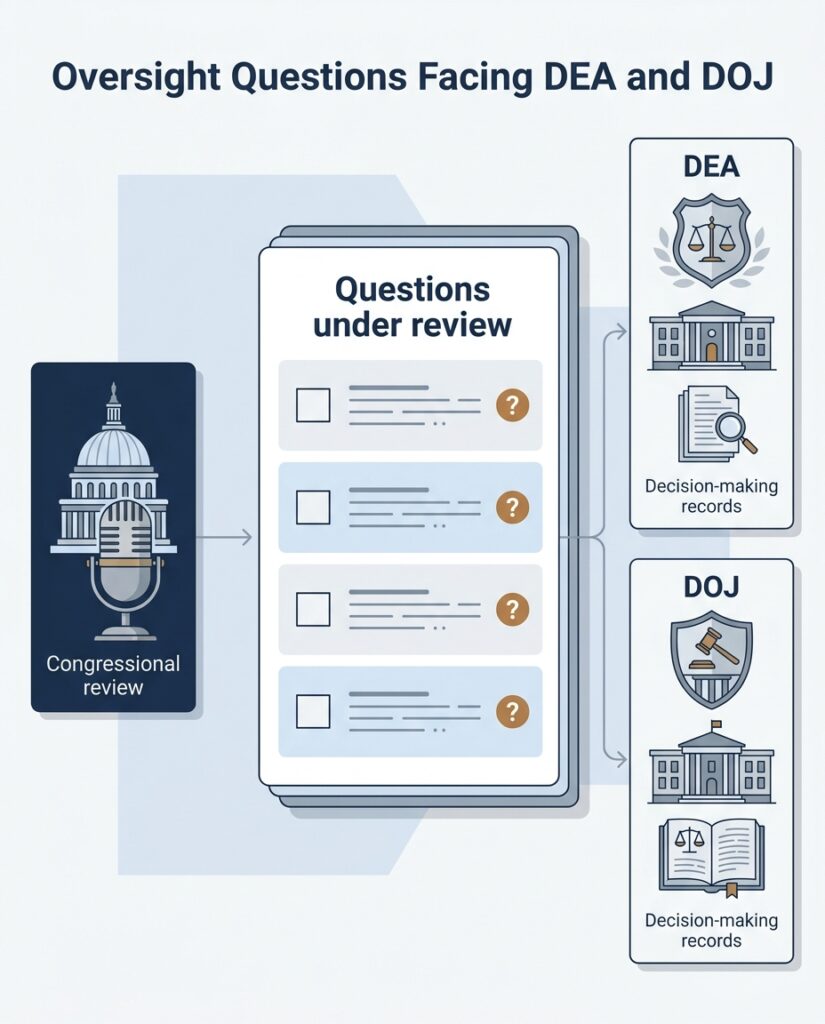
The House Oversight Committee investigation is expected to focus on how decisions were made and whether the DEA followed internal protocols.
Key questions include:
– Who authorized the strategy in the cases under review?
– What safeguards were in place to prevent fentanyl from reaching the public?
– How did the DEA assess risk before allowing shipments to continue moving?
– Did agents lose track of any shipments?
– Were Justice Department officials informed or involved?
– Were any policies changed after problems were identified?
Those questions go to the heart of federal oversight. Congress has authority to scrutinize executive branch agencies, particularly when public safety, taxpayer-funded law enforcement operations, and potential policy failures are involved.
The inquiry also arrives as Republicans in Congress continue to use committee investigations to examine the Biden administration’s handling of border security, narcotics trafficking, and federal law enforcement priorities.
The available research material does not include a detailed DEA response to the committee’s allegations. It also does not include a Justice Department statement addressing the specific inquiry.
That absence matters. Without official responses, the public record remains incomplete. DEA and DOJ officials may dispute the characterization of the tactic, provide operational context, cite ongoing investigations, or decline to comment on sensitive law enforcement methods.
For that reason, the allegations should be treated as claims made by congressional investigators unless and until additional documents, testimony, or official statements clarify what happened.
The Associated Press report is the primary available source for the existence of the House Republican probe and the broad nature of the allegations. Any publication of further details should be checked against the committee’s official correspondence, DEA statements, Justice Department materials, and court records if related prosecutions are identified.
The controversy underscores a persistent tension in drug enforcement: stopping an immediate shipment can protect the public in the short term, while tracking a shipment may help agents identify broader trafficking networks and prevent larger future flows.
That tradeoff becomes more difficult in fentanyl cases because small quantities can be highly dangerous, and once narcotics enter illicit distribution channels, law enforcement may not be able to recover them.
For communities affected by the opioid crisis, the issue is not abstract. Federal agencies are expected to prevent dangerous drugs from reaching neighborhoods while also dismantling the organizations that profit from them.
The House Oversight Committee investigation is likely to test whether the DEA can demonstrate that its tactics were controlled, justified, and consistent with public safety obligations.
The next phase of the investigation will likely depend on documents, agency briefings, and any response from DEA or DOJ officials. Lawmakers may seek internal communications, operational guidance, case records, or testimony from agency personnel involved in the strategy.
Until more information is released, the core facts remain limited: House Republicans are probing a DEA fentanyl strategy, the allegations involve shipments allegedly reaching U.S. streets, and the matter raises broader questions about drug enforcement, federal oversight, and public safety.
Read more as the committee investigation develops and federal agencies respond.