


Newsletter Subscribe
Enter your email address below and subscribe to our newsletter

Ideas Worth Building
OpenAI reportedly used thousands of AI agents to investigate the Navier-Stokes equations, one of mathematics’ hardest unsolved problems. Here’s what that could mean—and why it does not yet prove AI has solved it.
Reports that OpenAI has used thousands of AI agents to investigate the Navier-Stokes equations have put one of mathematics’ hardest problems back in the spotlight.
The headline version is tempting: artificial intelligence may have cracked a famous mathematical puzzle. But the careful version is more interesting—and more important. The OpenAI Navier-Stokes equations story is not simply about whether a machine “solved math.” It is about how automated research agents might help explore problems that have resisted human mathematicians for generations, and how difficult it remains to turn promising ideas into accepted proof.
The Navier-Stokes equations sit at the center of fluid dynamics. They help describe how fluids move: air over a wing, water through a pipe, currents in the ocean, turbulence in the atmosphere. They are among the most important equations in applied science, but they also contain one of pure mathematics’ most famous unresolved questions.
That tension—practical usefulness on one side, deep mathematical uncertainty on the other—is why any claim involving artificial intelligence mathematics and Navier-Stokes deserves attention. It also deserves caution.
The Navier-Stokes equations are a set of mathematical equations used to model fluid flow. In broad terms, they describe how the velocity of a fluid changes over time under the influence of forces, pressure, and viscosity.
For many real-world engineering and scientific purposes, versions of these equations work extraordinarily well. They are used in simulations of weather, aircraft design, ocean movement, combustion, and countless other systems where fluid motion matters.
But the equations are also notoriously difficult. Fluids can move smoothly in some settings and become turbulent in others. Small changes can cascade into complex structures. Mathematically, that complexity raises a profound question: do the equations always behave nicely, or can they break down?
The best-known unsolved problem concerns the three-dimensional incompressible Navier-Stokes equations. In simple terms, mathematicians want to know whether smooth starting conditions always lead to smooth solutions for all time, or whether the equations can develop a singularity—a point where the mathematical description becomes infinite or stops making sense.
This is not just a technical footnote. It is one of the Millennium Prize Problems, a small group of famously difficult math problems selected by the Clay Mathematics Institute. A complete solution would be a major mathematical breakthrough.
When people hear that the Navier-Stokes equations might “break down,” it can sound like physical fluids might suddenly behave impossibly. That is not the right way to think about it.
The question is mathematical. If a singularity exists, it would mean that under certain conditions the equations produce a solution that becomes too extreme to remain smooth. Depending on the formulation, that might involve quantities related to velocity, gradients, or vorticity becoming unbounded.
In physical reality, fluids are made of molecules, and mathematical models are idealizations. A singularity in the equations would not automatically mean nature contains literal infinities. But it would reveal something fundamental about the limits of one of science’s most important models.
If no such breakdown can occur, mathematicians need a proof showing that smooth solutions exist forever under the problem’s assumptions. If breakdown can occur, they need a valid counterexample showing it.
Either direction would be historic.
According to reports, OpenAI has used large numbers of automated research agents to probe the Navier-Stokes problem. The broad idea is that instead of assigning one model to answer one prompt, a system can deploy many AI agents to explore different parts of a research space.
In principle, OpenAI AI agents could attempt tasks such as:
– generating possible proof strategies;
– searching for special cases or counterexamples;
– translating informal reasoning into more formal mathematical steps;
– testing computational constructions;
– comparing approaches from prior mathematical literature;
– identifying gaps or contradictions in proposed arguments.
That kind of system is not the same as a lone chatbot producing a final answer. Automated research agents can be structured as a swarm of specialized workers: some propose ideas, others critique them, others attempt verification, and others search for alternatives.
If this is what OpenAI has done, the work would fit into a growing area of AI-assisted research: using artificial intelligence not merely to summarize existing papers, but to participate in the exploration phase of scientific and mathematical discovery.
But exploration is not proof.
The difference between a promising AI-generated idea and an accepted mathematical result is enormous.
For the Navier-Stokes equations, a genuine breakthrough would need to meet a very high standard. It would have to present a rigorous argument that experts can inspect, reproduce, and verify. If the claim is a proof of global regularity, it must show that solutions remain smooth under the required assumptions. If the claim is a counterexample, it must construct one in a way that satisfies the problem’s conditions.
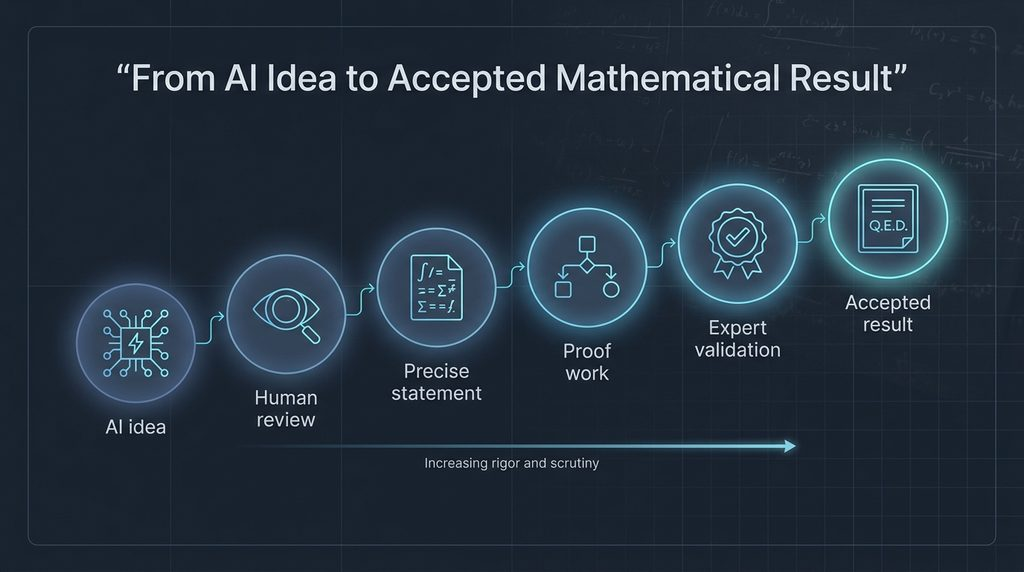
There are several stages between an AI system producing an interesting output and the mathematical community accepting a solution:
An AI system might identify a new angle, analogy, estimate, transformation, or computational pattern. This can be valuable even if it is incomplete. Many research projects begin with exactly this kind of clue.
A proof sketch may outline why an approach could work. But sketches often hide the hardest steps. In advanced mathematics, a missing bound, unjustified assumption, or subtle exception can invalidate an entire argument.
A stronger result would provide detailed reasoning that can be checked line by line. In some cases, formal proof systems can help verify mathematical claims, but not every advanced proof is immediately suited to formalization.
The final test is not whether an AI system is confident. It is whether qualified experts can verify the work. For a problem as famous as Navier-Stokes, any serious claim would face intense scrutiny from mathematicians and fluid dynamics specialists.
Until that process happens, it is safer to describe the reported work as AI-assisted investigation—not as a confirmed solution.
Skepticism around an AI mathematical proof is not anti-technology. It is how mathematics works.
Mathematics has a long history of proposed solutions to famous problems that later turned out to contain errors. The more prestigious the problem, the more careful the review must be. The Navier-Stokes equations are especially unforgiving because the difficulty lies in controlling behavior across all relevant cases, not just finding examples that appear to behave well.
AI adds new reasons for caution.
Large language models can generate convincing but incorrect arguments. They can cite nonexistent results, skip necessary assumptions, or produce reasoning that sounds mathematically fluent without being valid. Even more advanced automated research agents may generate outputs that require extensive human checking.
There is also the issue of reproducibility. If thousands of agents produce a result through a complex workflow, researchers need to know what was run, what assumptions were used, what intermediate claims were accepted, and how the final conclusion was verified. A result that cannot be independently reconstructed will struggle to gain acceptance.
Peer review matters too. For a Millennium Prize-level problem, acceptance would not come from a company announcement or a viral headline. It would come from sustained expert examination.
Even without a confirmed proof, the reported OpenAI Navier-Stokes equations effort matters because it points to a possible shift in how difficult research problems are attacked.
Mathematics often advances through a mix of intuition, symbolic manipulation, computation, collaboration, and relentless error-checking. AI agents could become useful in several parts of that process. They might help researchers map the literature, generate variations of known methods, test conjectures, or find overlooked connections.
That does not mean AI replaces mathematicians. In the near term, the more realistic model is AI as a research amplifier. A human researcher might use automated systems to explore more paths faster, while still relying on expert judgment to decide which paths are meaningful.
For fluid dynamics, even partial progress can be valuable. Better understanding of the Navier-Stokes equations can influence numerical simulations, turbulence research, and mathematical analysis of physical systems. The Millennium Prize question is pure mathematics, but it sits close to problems that matter in science and engineering.
One reason this story is controversial is that fluid dynamics already relies heavily on computation. Scientists simulate fluids all the time. Those simulations can be incredibly useful, but they are not the same as a proof of the Navier-Stokes Millennium problem.
A computer can test many scenarios and fail to find a singularity. That does not prove none exists. An AI system can generate a candidate singularity. That does not prove it satisfies the required equations. A model can produce a proof-like document. That does not mean every step is valid.
The standard for mathematics is exactness. A numerical experiment can inspire a theorem, but it usually cannot replace one.
This is where AI research controversy is likely to intensify. If automated systems become better at generating mathematical arguments, the bottleneck may shift from idea generation to verification. The scientific community will need reliable ways to check AI-generated reasoning, reproduce agent workflows, and separate genuine discoveries from persuasive noise.
The key question is not whether a headline says AI solved Navier-Stokes. The key question is whether there is a publicly available, technically detailed result that experts can evaluate.
Readers should watch for several signals:
– a primary technical report or paper;
– clear statement of which Navier-Stokes problem is being addressed;
– precise assumptions and definitions;
– a complete proof or counterexample;
– independent commentary from relevant mathematicians;
– reproducible methods or formal verification where applicable;
– peer review or sustained expert validation.
If those pieces emerge, the story becomes much bigger. If they do not, the story remains an important example of AI-assisted exploration—but not a confirmed mathematical breakthrough.
OpenAI’s reported use of thousands of automated research agents on the Navier-Stokes equations is a fascinating sign of where advanced AI research may be heading. It suggests that AI systems could help explore mathematical puzzles that are too vast or intricate for traditional trial-and-error alone.
But the Navier-Stokes problem is not solved by an intriguing output, a plausible sketch, or a controversial claim. It is solved only when the mathematical community can verify a rigorous proof or counterexample.
That distinction matters. The future of artificial intelligence mathematics may be extraordinary, but in mathematics, the final authority is still proof.