



Newsletter Subscribe
Enter your email address below and subscribe to our newsletter

Ideas Worth Building

Safety-net primary care research on somatic therapy for PTSD raises important questions about access, acceptability, and trauma-informed care—but it should not be mistaken for proof of clinical effectiveness.
For many people with post-traumatic stress disorder, the first realistic point of contact with the healthcare system is not a specialty trauma clinic. It is a primary care visit.
That matters for researchers studying mental health access. PTSD can affect sleep, concentration, relationships, pain, substance use, cardiovascular health, and day-to-day functioning. Yet evidence-based PTSD treatment is often difficult to obtain, especially for patients who rely on safety-net clinics, have unstable insurance coverage, face transportation barriers, or live in communities with limited behavioral health capacity.
A research article titled “The Acceptability of Somatic Therapy for PTSD Among Patients at an Urban Safety Net Primary Care Clinic” points to an important research question: not simply whether somatic therapy for PTSD works, but whether patients in a real-world primary care safety-net setting would be willing to consider a body-based approach at all.
That distinction is essential. Acceptability research can help determine whether an intervention is understandable, appealing, culturally appropriate, feasible, and worth studying further. It does not, by itself, prove that an intervention reduces PTSD symptoms or should replace established PTSD treatment.
Post-traumatic stress disorder is a mental health condition that can occur after exposure to trauma, such as violence, serious injury, sexual assault, combat, disaster, or other life-threatening events. Symptoms may include intrusive memories, nightmares, avoidance of reminders, emotional numbing, hyperarousal, irritability, sleep disturbance, and changes in mood or cognition.
PTSD diagnosis should be made by a qualified clinician using appropriate clinical assessment. Symptoms can overlap with depression, anxiety, substance use disorders, traumatic brain injury, chronic pain, grief, and medical conditions, which makes careful evaluation important.
For researchers and healthcare systems, PTSD in primary care is a major access issue. Primary care clinics frequently serve as the de facto mental health front door, particularly for patients who may not have access to specialty psychiatry or trauma-focused psychotherapy. This is especially true in safety-net settings, where patients may experience higher exposure to trauma-related social stressors while also facing structural barriers to care.
Somatic therapy is a broad term for therapeutic approaches that incorporate bodily awareness and physiological regulation into mental health care. In trauma-related work, somatic or body-based therapy may include practices such as:
– Noticing bodily sensations in a structured, supported way
– Breathing and grounding exercises
– Movement-based regulation strategies
– Skills for identifying tension, activation, or shutdown
– Techniques designed to help patients recognize and modulate stress responses
The core idea is that trauma is not experienced only as a set of thoughts or memories. Many trauma survivors also experience persistent bodily states: muscle tension, startle responses, shallow breathing, gastrointestinal distress, dissociation, numbness, or a sense of being chronically “on alert.”
However, “somatic therapy” is not one standardized treatment. Different clinicians, programs, and studies may use the term in different ways. That variability is important when evaluating research. A study about one specific body-based intervention cannot automatically be generalized to all somatic approaches.
Current PTSD treatment guidelines generally prioritize trauma-focused psychotherapies with a stronger evidence base, such as prolonged exposure, cognitive processing therapy, and trauma-focused cognitive behavioral approaches. Some guidelines also discuss eye movement desensitization and reprocessing and certain medications, depending on the clinical context and patient needs.
This does not mean other approaches are irrelevant. It means researchers and clinicians should be precise about evidence level. A body-based therapy may be promising, acceptable, useful as an adjunct, or worthy of further study without being considered a first-line PTSD treatment.
For patients, the practical takeaway is straightforward: PTSD treatment decisions should be made with licensed healthcare professionals. People experiencing trauma-related symptoms should not rely on educational articles or wellness trends as a substitute for clinical care.
Safety-net clinics and hospitals provide care for many patients who are uninsured, underinsured, publicly insured, or otherwise medically underserved. These settings are central to health equity because they care for populations that may face overlapping barriers, including poverty, housing instability, language barriers, immigration-related concerns, racism, community violence, and limited access to specialty care.
Studying somatic therapy for PTSD in an urban safety-net primary care clinic raises different questions than studying it in a specialty mental health practice. Researchers may need to consider:
– Whether patients find the concept understandable and relevant
– Whether the intervention can fit into primary care workflows
– Whether clinicians have adequate training and supervision
– Whether brief visits allow enough time for safe delivery
– Whether patients can attend multiple sessions
– Whether the approach is culturally responsive and trauma-informed
– Whether privacy, trust, and continuity of care are sufficient
These implementation questions can determine whether an intervention that appears promising in theory is actually usable in the setting where patients receive care.
Treatment acceptability refers to how patients, clinicians, or other stakeholders perceive an intervention before, during, or after receiving it. In PTSD care, acceptability can include whether patients believe a treatment makes sense, whether they feel safe engaging with it, whether it aligns with their values, and whether they would recommend it or continue it.
For somatic therapy, acceptability may be especially important. Body-based approaches can feel validating for some trauma survivors, particularly those who experience trauma through physical symptoms. For others, focusing on the body may feel uncomfortable, triggering, unfamiliar, or culturally mismatched.
That is why acceptability should not be assumed. It should be studied.
Acceptability research may examine questions such as:
– Are patients interested in somatic therapy for PTSD?
– Do they understand what the therapy involves?
– Do they perceive it as safe and respectful?
– Would they prefer it alone, as an adjunct, or not at all?
– What concerns would affect participation?
– What logistical barriers would prevent attendance?
These questions are not secondary details. They are central to mental health access.
The research article identifies a study focus: the acceptability of somatic therapy for PTSD among patients at an urban safety-net primary care clinic. Based on that title and available research summary, the appropriate interpretation is that the work is relevant to patient interest, feasibility, and access in a primary care population.
It should not be interpreted as proof that somatic therapy treats, cures, or reduces PTSD symptoms unless the original study directly measured clinical outcomes and reported such findings. The available research record does not provide the study authors, publication date, sample size, methods, intervention protocol, acceptability measures, results, or limitations.
For researchers, that means these research articles are best treated as a starting point for evaluating the original research rather than as a complete evidence base. Key details to review include:
– Study design
– Recruitment setting and patient population
– PTSD screening or diagnostic criteria
– Definition of somatic therapy used in the study
– How acceptability was measured
– Whether participants had prior treatment experience
– Whether clinical outcomes were measured
– Attrition, selection bias, and generalizability limits
Without those details, any strong efficacy claim would be premature.
It can be tempting to treat acceptability as a “soft” outcome compared with symptom reduction. But in mental health services research, acceptability is often a prerequisite for effectiveness in the real world.
An intervention cannot help patients who will not start it, cannot continue it, or cannot access it. This is particularly relevant in safety-net primary care, where even well-supported PTSD treatments may be unavailable, understaffed, difficult to schedule, or mismatched with patient needs.
Acceptability research can help identify whether a body-based therapy is worth testing in larger studies. It can also reveal implementation barriers early, before systems invest in a program that patients may not want or cannot use.
For example, if patients express strong interest but cite transportation barriers, researchers might study integrated primary care delivery. If patients are interested but concerned about body-focused exercises, trauma-informed orientation and patient choice may become central design features. If clinicians report uncertainty about scope or training, implementation research may need to address workforce development before effectiveness trials.
Any research on somatic therapy for PTSD should be grounded in trauma-informed care. In practice, that means prioritizing safety, transparency, collaboration, patient autonomy, and cultural humility.
Body-based interventions require particular care because the body can be a site of trauma memory, distress, dissociation, or shame. A trauma-informed approach should avoid forcing exposure to sensations or movements that patients do not consent to. It should also clearly explain what the intervention involves, what choices the patient has, and how distress will be managed.
For primary care settings, trauma-informed care also includes workflow design. Staff interactions, room setup, screening procedures, privacy protections, referral pathways, and follow-up processes can all influence whether patients experience care as safe and trustworthy.
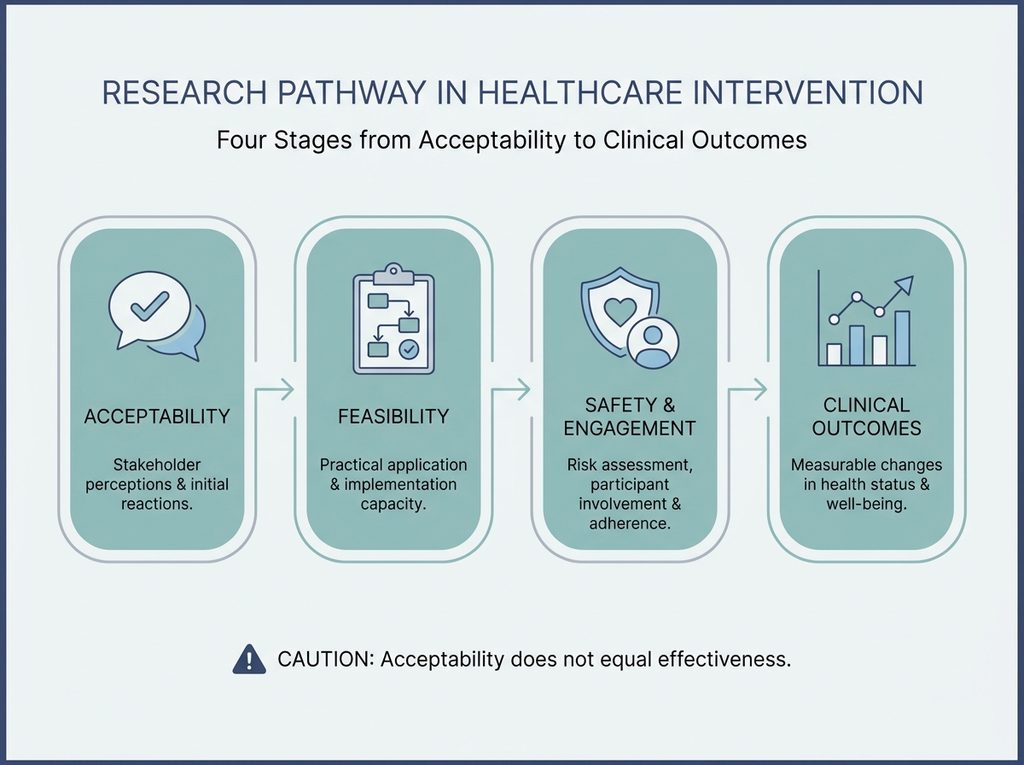
The next step after acceptability research is not to assume effectiveness. It is to design stronger studies.
For somatic therapy for PTSD in primary care, future research may need to address several questions:
1. Which specific somatic intervention is being tested?
2. Is it delivered by licensed mental health clinicians, primary care providers, trained coaches, or another workforce?
3. Is it intended as a stand-alone treatment or an adjunct to evidence-based PTSD care?
4. What outcomes are measured—PTSD symptoms, functioning, sleep, pain, engagement, retention, or patient satisfaction?
5. How are safety events, symptom worsening, and dropout tracked?
6. Does the intervention improve access for underserved patients, or does it unintentionally create new barriers?
These questions matter because PTSD treatment research must balance innovation with caution. Novel or less-studied approaches may be worth investigating, particularly when they address access gaps. But vulnerable patients should not be offered unproven treatments as though they are established cures.
Somatic therapy may be of interest to PTSD researchers because trauma often involves both psychological and physiological distress. In safety-net primary care, where access to specialty PTSD treatment can be limited, body-based approaches may raise important questions about patient preference, feasibility, and health equity.
A research article titled “The Acceptability of Somatic Therapy for PTSD Among Patients at an Urban Safety Net Primary Care Clinic” talks on acceptability in an urban safety-net primary care clinic appears to contribute to that access-focused conversation. Its value lies in helping researchers ask whether patients are open to this type of care and what conditions may make participation realistic.
But acceptability is not the same as clinical effectiveness. Researchers, clinicians, and health systems should interpret this work as part of a broader evidence-building process, alongside established PTSD guidelines and careful attention to trauma-informed care.
Patients with PTSD symptoms should consult licensed healthcare professionals for diagnosis and treatment planning.