


Newsletter Subscribe
Enter your email address below and subscribe to our newsletter

Ideas Worth Building
For consumers looking for pain relief or a way out of opioid use, kratom can sound like a middle ground: plant-based, legal in many places, and widely marketed in smoke shops, supplement stores, and online. But doctors and public health agencies continue to warn that the story is more complicated than the marketing suggests.
A recent case report in the *Journal of the American Pharmacists Association* describes a man who developed withdrawal symptoms after stopping chronic use of a concentrated 7-hydroxymitragynine product, a potent kratom-related alkaloid often referred to as 7-OH. His symptoms included nausea, diarrhea, abdominal cramping, restlessness, chills, clamminess, and anxiety — symptoms that overlap with classic opioid withdrawal. Emergency department clinicians treated him with buprenorphine-naloxone and supportive medications, then referred him for ongoing treatment.
The report does not prove that every kratom product carries the same risk. It does, however, highlight a growing concern: concentrated kratom extracts may produce stronger opioid-like effects than many consumers expect, and stopping them can trigger clinically significant withdrawal.
Kratom comes from the leaves of *Mitragyna speciosa*, a tree native to Southeast Asia. In the U.S., it is commonly sold as powders, capsules, gummies, drinks, and concentrated extracts. Consumers often report using it for pain, anxiety, mood, energy, or to manage symptoms related to opioid withdrawal.
That last use is especially important. In the middle of the opioid crisis, some people turn to kratom because they want to reduce or stop prescription opioids, heroin, or illicit fentanyl without entering formal treatment. Others may see kratom supplement marketing that frames it as a natural wellness product or an opioid alternative.
But kratom is not approved by the U.S. Food and Drug Administration to treat pain, opioid use disorder, opioid withdrawal, anxiety, depression, or any other medical condition. That does not mean everyone who uses kratom will experience harm. It does mean consumers should be careful about treating marketing claims as medical evidence.
Kratom’s effects appear to come largely from alkaloids such as mitragynine and 7-hydroxymitragynine. These compounds can interact with opioid receptors in the body. That receptor activity is one reason people may feel pain relief or opioid-like effects — and also why kratom dependency and withdrawal are public health concerns.
Classic opioid withdrawal can include nausea, vomiting, diarrhea, muscle aches, sweating, chills, anxiety, restlessness, insomnia, runny nose, watery eyes, and strong cravings. It is usually not described as medically dangerous in the same way as alcohol or benzodiazepine withdrawal, but it can be severe, destabilizing, and difficult to manage without care.
Reports of kratom withdrawal often include overlapping symptoms: gastrointestinal distress, restlessness, anxiety, chills, sweating, irritability, sleep problems, and cravings. The case report involving concentrated 7-OH is notable because clinicians evaluated the patient using the Clinical Opioid Withdrawal Scale and treated him in a way that resembled opioid withdrawal management.
Still, the comparison needs caution. A single case report cannot tell consumers how often severe kratom withdrawal happens, which products are most risky, or how withdrawal compares across all forms of kratom. Kratom products vary widely, and a plain leaf powder is not necessarily the same as a concentrated extract.
The case report centered on a concentrated 7-OH product, not ordinary brewed tea or low-concentration leaf material. The patient reportedly transitioned from kratom to concentrated 7-OH because he perceived stronger and faster opioid-like effects and needed smaller quantities to prevent withdrawal.
That pattern matters for consumers. Concentrated extracts can deliver a more potent exposure than people may realize, especially when labels are unclear, products are inconsistently tested, or marketing emphasizes strength without adequately explaining risk.
This is where kratom side effects and kratom addiction risk become harder to evaluate. Consumers are not always choosing from standardized, clinically studied products. They may be choosing from a marketplace with variable potency, inconsistent labeling, and limited medical oversight.
This is the question many consumers are really asking — and the honest answer is not simple.
Prescription opioids, heroin, and illicit fentanyl have well-documented risks, including respiratory depression, overdose, and death. The scale of opioid-related harm in the U.S. is large and well established. FDA-approved medications for opioid use disorder, including buprenorphine and methadone, have a much stronger evidence base than kratom self-treatment.
Kratom is different from conventional opioids in important ways, but “different” does not mean “safe.” Public health agencies have raised concerns about dependence, withdrawal, adverse effects, contamination, product variability, and the way kratom is marketed. The FDA has specifically warned consumers about kratom safety concerns and has not approved kratom products for medical use.
A more useful framing is this:
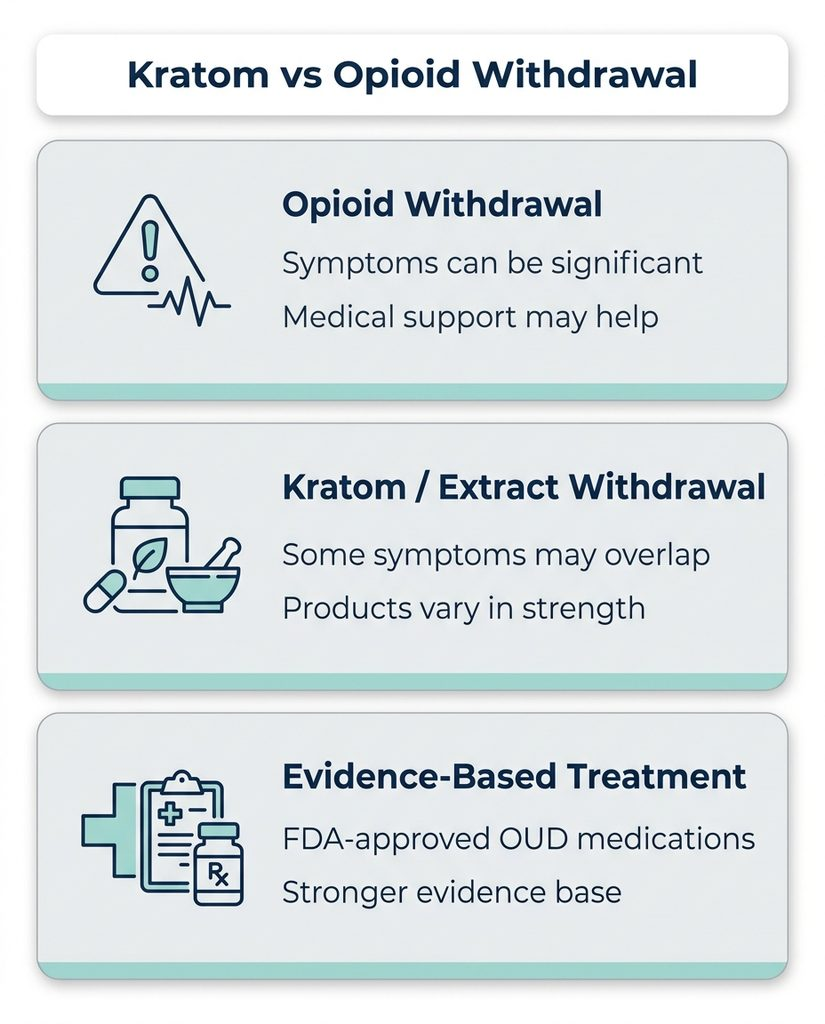
For someone using illicit opioids, kratom may seem like a harm-reduction step. But without medical supervision, it can also delay access to proven treatment, create a new dependency, or expose the person to unpredictable products.
Kratom supplement marketing often leans on words like “natural,” “botanical,” or “wellness.” Those words can make a product feel safer than it is. Natural substances can still have drug-like effects. They can still cause side effects, interact with medications, and lead to dependence.
Consumers should be especially cautious of products marketed for opioid withdrawal, pain treatment, anxiety, or depression. Those are medical claims. If a product is being promoted as a treatment but has not gone through the same approval process as a medication, the evidence may not match the promise.
Red flags include:
– Claims that kratom is a proven opioid withdrawal aid
– Promises of pain relief without dependency risk
– “Extra strength” or concentrated extract products with unclear labeling
– Advice to replace prescribed treatment without talking to a clinician
– Marketing that minimizes withdrawal, side effects, or interactions
The concern is not only what kratom does pharmacologically. It is also how people encounter it: as a legal supplement-like product in a marketplace that may move faster than clinical research and regulation.
If you are using kratom because you are trying to stop opioids, or if you are using opioids and kratom together, it is worth talking with a medical professional. That is especially true if you have a history of opioid use disorder, have tried to stop and could not, or are experiencing withdrawal symptoms when you miss kratom doses.
Evidence-based care for opioid use disorder may include medications such as buprenorphine, methadone, or naltrexone, along with counseling, recovery support, harm-reduction services, and treatment for pain or mental health conditions when needed. These options have been studied more extensively than kratom self-treatment.
Do not abruptly stop prescribed medications or attempt to manage opioid or kratom withdrawal alone if you are medically unstable, pregnant, using multiple substances, or at risk of relapse to illicit opioids. A clinician can help assess symptoms, reduce risks, and connect you with appropriate care.
Kratom research is still developing. Public health agencies, addiction specialists, toxicologists, and consumer advocates do not always frame the risks in the same way. Some people report benefits. Others report dependence, withdrawal, adverse effects, or difficulty stopping.
The biggest uncertainties include:
– How withdrawal risk differs between plain kratom leaf, extracts, and concentrated 7-OH products
– Which consumers are most vulnerable to kratom dependency
– How kratom interacts with other drugs or health conditions
– How often adverse events are caused by kratom itself versus contamination, co-use, or product variability
– Whether any kratom-derived compound can be developed into a safe, effective, regulated medication
Those uncertainties are exactly why consumers should be wary of simple claims in either direction. Kratom should not be portrayed as identical to fentanyl or prescription opioids. It also should not be promoted as a risk-free natural alternative.
Kratom occupies a confusing space in American health culture: legal in many places, marketed like a supplement, used by some people as an opioid substitute, and increasingly discussed by doctors as a substance that can cause opioid-like dependence and withdrawal.
The latest doctors report on concentrated 7-OH adds to the caution. It does not settle the kratom debate, but it reinforces an important consumer message: if a product produces opioid-like effects, it may also carry opioid-like withdrawal risks.
For people seeking relief from pain or opioid dependence, the safest next step is not to rely on marketing claims. It is to talk with a qualified clinician, ask about evidence-based treatment options, and understand the risks before using or stopping kratom products.
**Read the Research:** Review the case report, “Management of acute withdrawal from 7-hydroxymitragynine after high-dose chronic use: A case report,” in the *Journal of the American Pharmacists Association*.
External Sources