


Newsletter Subscribe
Enter your email address below and subscribe to our newsletter

Ideas Worth Building

Four major chatbots have been used to rank jobs at risk from AI, but chatbot agreement is not a labor-market forecast. Here is what the evidence suggests about automation risk, job redesign, and new opportunities.
The question behind many workplace conversations is simple: which jobs will be replaced by AI?
A recent NewsBreak-shared article used a timely hook: ChatGPT, Gemini, Claude and Perplexity were reportedly asked to rank the jobs most likely to be replaced by AI. That kind of chatbot comparison is interesting because it shows what today’s popular AI systems tend to associate with automation risk.
But it is not the same thing as a labor-market forecast.
The available source material for this article did not include the full NewsBreak article body, the exact prompt used, the chatbot versions, or the complete rankings from each model. That matters. Without those details, it is not possible to independently verify the exact lists or confirm which single job, if any, appeared on every chatbot’s list.
So the smarter way to read this topic is not as a countdown of doomed careers. It is as a map of exposed tasks: work that is repetitive, text-heavy, rules-based, easy to digitize, or already performed inside software systems.
Below is a practical look at 10 jobs often described as being at risk from AI, how credible labor research frames the issue, and what workers can do next as the future of work changes.
If four chatbots name the same job as vulnerable, that may feel persuasive. It can suggest there is a common pattern in public discussion about AI job replacement. But chatbot answers are shaped by prompts, training data, product design, safety rules, and the wording of the question.
A chatbot ranking can reflect what people commonly say about automation. It does not prove that employers will eliminate a role, that customers will accept the replacement, or that regulators will allow it.
Labor markets move through slower and messier forces: wages, technology costs, customer expectations, legal requirements, union rules, demographics, management habits, and the availability of workers with new skills.
That distinction is important. A job can be highly exposed to AI without disappearing. In many cases, AI adoption changes the tasks inside a job before it changes the job title itself.
The jobs most often discussed in connection with automation risk tend to share several traits:
– The work is repetitive or rule-based.
– The work happens mainly on a computer.
– Outputs can be checked quickly, such as a form, summary, invoice, transcript, code snippet, or customer reply.
– The role involves large amounts of text, data, or pattern recognition.
– The employer can measure productivity gains from automation.
That does not mean every worker in those roles faces the same employment risk. A senior employee who handles exceptions, clients, strategy, supervision, or compliance is in a different position than someone doing routine production work.
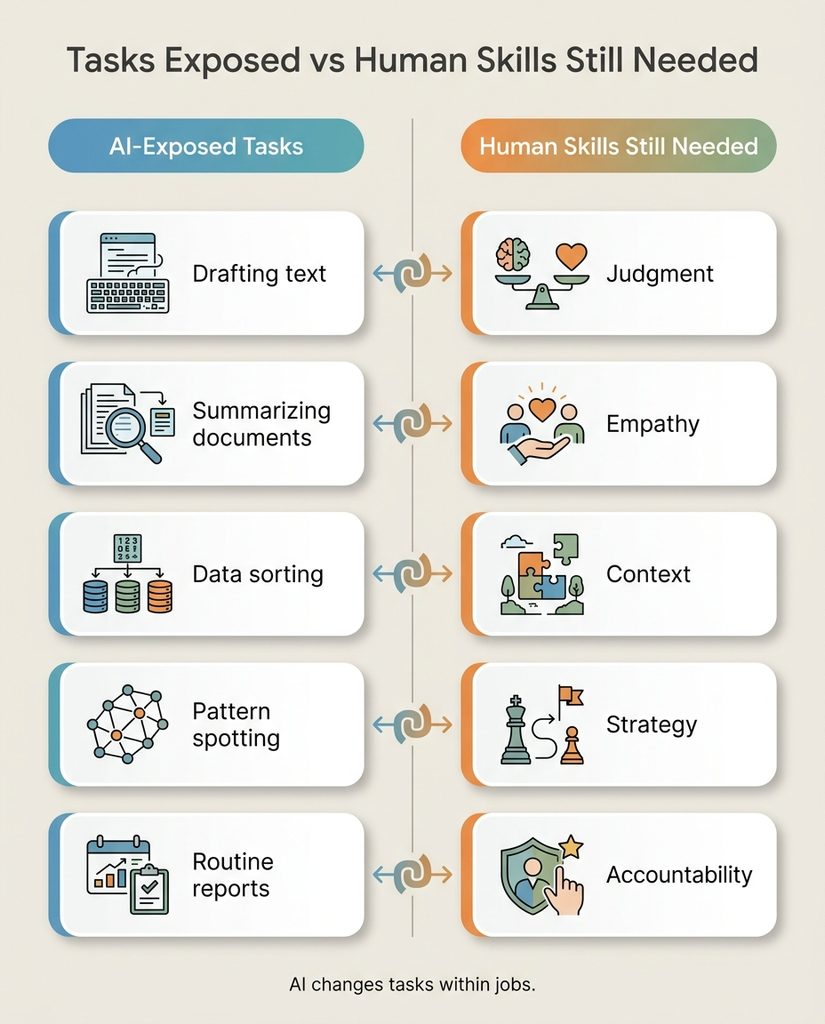
The following list should be read as a task-exposure guide, not a prediction that these roles will vanish. These are the kinds of roles chatbots and labor commentators commonly associate with artificial intelligence jobs disruption because important parts of the work can be automated or accelerated.
Customer support is one of the most visible areas for chatbots and employment disruption. AI systems can answer common questions, route tickets, summarize complaints, draft replies, and help agents find information faster.
The risk is highest for simple, high-volume support: password resets, order status questions, appointment changes, refund policies, and basic troubleshooting.
The opportunity is in more complex support roles. Workers who can handle escalations, empathy-heavy situations, technical problems, account management, and quality control may become more valuable as basic inquiries are automated.
Data entry has long been vulnerable to automation because the work often involves moving information from one system into another. AI tools, optical character recognition, document processing software, and workflow automation can reduce the need for manual entry.
The exposed tasks include transcribing forms, updating records, extracting information from invoices, and checking standardized fields.
But the work does not simply disappear in every organization. It often shifts toward data validation, exception handling, records management, privacy compliance, and process improvement.
AI can generate call scripts, personalize email sequences, qualify leads, and power automated outreach tools. That creates automation risk for roles built around repetitive cold calling or templated sales messages.
However, sales is not only about sending messages. Relationship building, negotiation, trust, timing, and industry knowledge still matter. The workers most likely to benefit are those who use AI to research prospects, tailor outreach, and focus more time on high-quality conversations.
Bookkeeping is highly software-based, and many tasks follow repeatable rules. AI can categorize expenses, flag anomalies, match transactions, draft reports, and help reconcile accounts.
That creates exposure for routine clerical accounting work. But it also increases the need for people who can interpret financial information, catch errors, explain decisions, manage controls, and understand tax or regulatory requirements.
In other words, the future may involve fewer hours spent entering numbers and more time spent checking whether the numbers make sense.
Administrative work covers a wide range of responsibilities, so the automation risk varies. AI tools can schedule meetings, draft emails, summarize documents, prepare agendas, create travel options, and organize notes.
The most exposed tasks are routine coordination and document preparation. The less exposed parts involve judgment, confidentiality, relationship management, executive support, office problem-solving, and handling unexpected situations.
For many administrative professionals, AI may become a productivity tool rather than a full replacement.
Legal work is text-heavy, and AI systems are increasingly capable of summarizing documents, searching large files, comparing contracts, drafting basic language, and assisting with discovery.
That makes some paralegal tasks exposed, especially document review and standard form preparation. But law is also a high-stakes, regulated profession where accuracy, confidentiality, and accountability matter.
The likely near-term shift is task redesign: legal support workers may spend less time on first-pass review and more time verifying outputs, managing workflows, preparing case materials, and supporting attorneys with research and organization.
Machine translation has improved significantly, especially for common languages and straightforward documents. AI can quickly translate emails, product descriptions, internal documents, and basic customer communications.
The exposure is highest for routine written translation where perfect nuance is less critical.
The risk is lower in contexts that require cultural judgment, legal precision, medical accuracy, live interpretation, diplomacy, literature, marketing nuance, or sensitive human interaction. Workers who combine language skill with subject-matter expertise may be better positioned.
Generative AI can draft blog posts, ads, product descriptions, social captions, outlines, emails, and summaries. That has obvious implications for entry-level or high-volume content work.
Still, producing text is not the same as building a brand, understanding an audience, reporting original information, developing strategy, or making editorial judgments. AI can create plausible copy quickly, but it can also be generic, inaccurate, or misaligned with a company’s voice.
The content roles that may hold up best are those tied to research, editing, brand strategy, subject expertise, original reporting, audience insight, and performance analysis.
AI image and design tools can create mockups, resize assets, generate variations, remove backgrounds, and produce quick visual concepts. That creates pressure on low-complexity design production work.
But design is not only image generation. Strong designers solve communication problems. They understand hierarchy, usability, brand systems, accessibility, campaigns, clients, and context.
The risk is greatest for commodity visuals. The opportunity is in creative direction, brand design, user experience, art direction, and the ability to use AI tools as part of a broader creative process.
AI coding assistants can generate functions, explain code, suggest fixes, write tests, and help developers move faster. That raises questions about entry-level programming work, especially tasks that involve boilerplate code or common patterns.
But software development is also about architecture, security, product tradeoffs, debugging complex systems, collaborating with teams, and understanding user needs.
AI may reduce some routine coding demand while increasing expectations for developers to work faster. It may also create demand for people who can evaluate AI-generated code, integrate tools, manage data pipelines, improve security, and build AI-enabled products.
The strongest labor research generally avoids saying that whole jobs will simply disappear because of AI. Instead, it talks about exposure, task automation, job redesign, and occupational transitions.
The World Economic Forum’s Future of Jobs research has emphasized that technology adoption can both displace and create work. It has pointed to pressure on clerical and administrative roles while also identifying growth in areas such as AI, data, and technology-enabled work.
McKinsey’s research on generative AI has similarly focused on tasks and transitions. Its work suggests that generative AI can affect knowledge work, including customer operations, marketing and sales, software-related work, and research-heavy functions. That does not mean everyone in those fields loses a job. It means the mix of tasks may change quickly.
Goldman Sachs has described broad exposure to generative AI across many occupations, especially where work involves information processing. But exposure is not the same as unemployment. In some roles, AI may automate a portion of tasks while increasing productivity or changing what workers are expected to do.
The OECD has also framed AI exposure as a policy and workplace issue, not just a technology issue. Outcomes depend on how employers adopt tools, how workers are trained, and how institutions respond.
The International Labour Organization has warned that clerical work is especially exposed to generative AI, while also emphasizing that many jobs are more likely to be augmented than fully automated.
The U.S. Bureau of Labor Statistics takes a different but useful angle: occupational projections are based on broad economic demand, demographics, industry growth, and technology change. BLS projections can help separate short-term hype from longer-term workforce patterns.
Taken together, these sources point to a more balanced conclusion: AI job replacement is real in some tasks and roles, but the bigger story is job redesign.
Focusing only on jobs at risk from AI misses the other side of the workforce impact of AI. New tools create new responsibilities. Some become formal job titles; others become skills added to existing roles.
Here are areas likely to grow as AI adoption spreads.
Companies need people who can identify where AI helps, where it creates risk, and how it fits into daily operations. That can include AI project managers, automation consultants, operations analysts, and process designers.
AI depends on data quality. Organizations need workers who can manage, clean, interpret, protect, and govern data. Data analysts, data engineers, business intelligence specialists, and data governance professionals may become more important.
AI outputs need checking. That creates work in model evaluation, content review, compliance testing, red-teaming, fact-checking, and quality assurance. In many industries, the human reviewer becomes the safety layer.
More AI adoption can increase security and privacy complexity. Organizations need people who understand access control, data leakage, vendor risk, policy, monitoring, and incident response.
One of the most realistic opportunities is not becoming an “AI worker” in the abstract. It is becoming a better accountant, nurse administrator, marketer, teacher, analyst, designer, lawyer, or operations manager who knows how to use AI responsibly.
In many fields, the advantage may go to people who combine domain expertise with AI fluency.
Workers do not need to panic, but they should not ignore the shift. The practical response is to move toward tasks that are harder to automate and learn how to use AI tools safely.
Useful skills include:
– AI literacy: knowing what tools can and cannot do.
– Verification: checking AI outputs for accuracy, bias, and missing context.
– Data skills: understanding spreadsheets, databases, dashboards, and basic analytics.
– Communication: explaining complex information clearly to customers, managers, and teams.
– Domain expertise: developing knowledge that generic tools do not have.
– Workflow design: finding where automation saves time without creating new risks.
– Privacy and security awareness: protecting sensitive information when using AI systems.
– Human judgment: handling exceptions, conflict, ethics, trust, and responsibility.
The safest career strategy is not to compete with AI on repetitive output. It is to use AI while strengthening the judgment, context, and accountability that employers still need from people.

The phrase “jobs replaced by AI” attracts attention because it speaks to a real fear. But the better question is: which tasks are exposed, and how can workers move toward higher-value work?
Customer support, data entry, routine writing, administrative work, bookkeeping, basic design, and some coding tasks may face meaningful automation risk. Yet credible labor research points to a more complicated future than mass replacement. AI can eliminate some tasks, redesign others, and create new demand for people who know how to manage, verify, and apply the technology.
For workers, the goal is not to predict one perfect career path. It is to keep learning, watch how AI is changing your specific field, and build skills that make you useful in an AI-enabled workplace.
Read More: Keep exploring how automation, artificial intelligence jobs, and the future of work are changing the way people build careers.
NewsBreak: “I asked ChatGPT, Gemini, Claude and Perplexity to rank the 10 jobs most likely to be replaced by AI — here’s what they all agreed on”, World Economic Forum Future of Jobs Report 2023, McKinsey research on generative AI and the future of work, Goldman Sachs research on generative AI labor-market exposure, OECD research on AI and employment exposure, International Labour Organization research on generative AI and jobs, U.S. Bureau of Labor Statistics occupational outlook and employment projections