


Newsletter Subscribe
Enter your email address below and subscribe to our newsletter

Ideas Worth Building

A global watchdog has warned that AI cyber risk is an immediate concern for financial stability as banks, markets, and payment systems expand their use of artificial intelligence.
Artificial intelligence is becoming a core part of modern finance, but global regulators are warning that the same technology could intensify one of the financial system’s most serious vulnerabilities: cyber risk.
A global financial watchdog has identified AI-driven cybersecurity threats as an immediate concern for the financial system, according to reporting by Daily Sabah. The warning reflects a growing view among regulators that artificial intelligence is not only a productivity tool for banks, insurers, payment providers, and market operators, but also a force that can change how fast and widely cyberattacks unfold.
The issue is not that AI creates cyber risk from nothing. Financial institutions have long been prime targets for hackers, fraud rings, ransomware groups, and state-linked attackers. The concern is that artificial intelligence can increase the speed, scale, personalization, and sophistication of attacks against firms that are already deeply interconnected.
For a sector built on trust, uptime, and fast-moving transactions, that matters.
Financial institutions are adopting artificial intelligence across a wide range of activities, including fraud detection, customer service, compliance monitoring, trading support, software development, and operational risk management.
At the same time, attackers can use similar tools to improve their own methods. AI can help generate convincing phishing messages, automate reconnaissance, identify software weaknesses, imitate trusted communications, or support fraud attempts at much larger scale.
That combination has turned AI cyber risk into more than a technical issue. It is now a financial stability issue.
A cyberattack against one company can be damaging. But a major disruption affecting payment networks, clearing systems, cloud service providers, market infrastructure, or several large institutions at once could have broader consequences. In tightly connected financial markets, operational failures can spread quickly if firms depend on the same vendors, data flows, or digital systems.
That is why global watchdogs are focusing not only on individual attacks, but also on system-wide exposure.
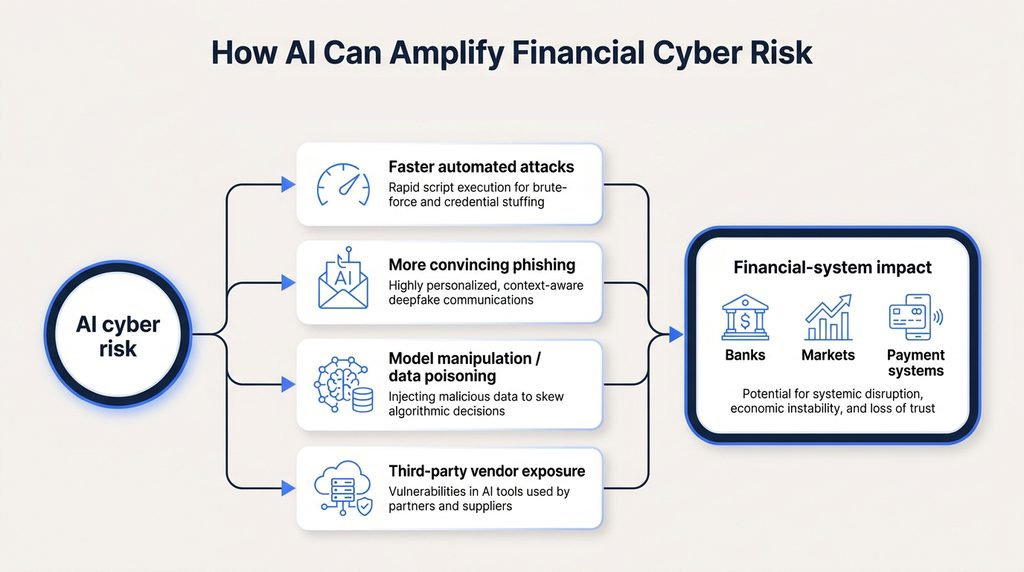
AI can affect cybersecurity in several practical ways. Some are already familiar to security teams, while others are still developing as financial institutions and attackers experiment with new tools.

Artificial intelligence can reduce the time needed to scan systems, craft malicious code, test attack paths, or adapt messages for different targets. Even when AI does not replace human attackers, it can make lower-skilled attackers more effective and help experienced attackers move faster.
For financial institutions, speed is a major concern. Banks and payment providers operate in real time. If an attacker can exploit a weakness quickly, firms may have less time to detect suspicious activity, isolate systems, and contain damage.
Phishing remains one of the most common entry points for cyber incidents. AI can make phishing harder to spot by generating messages that sound natural, match an organization’s tone, and appear tailored to a specific employee, customer, or executive.
That raises the risk of credential theft, fraudulent payment instructions, business email compromise, and unauthorized access to sensitive systems.
As financial institutions use AI models for fraud detection, credit processes, compliance alerts, and operational monitoring, those models themselves can become targets.
Attackers may try to manipulate inputs, corrupt training data, or exploit weaknesses in how models interpret information. In a financial setting, that could affect fraud controls, risk assessment, transaction monitoring, or customer authentication.
This does not mean every AI system is unsafe. It does mean firms need to treat AI models as part of their critical technology environment, not as experimental tools sitting outside standard cybersecurity controls.
Many financial firms rely on outside technology providers, including cloud platforms, software vendors, analytics tools, and AI service providers. This creates efficiency, but it also concentrates risk.
If several major firms depend on the same vendor or infrastructure provider, a cyber incident at that third party could affect many institutions at the same time. AI adoption may deepen those dependencies, especially when firms use external models, data pipelines, or managed services.
Regulators have increasingly focused on third-party risk because operational resilience depends on more than a bank’s internal controls. It also depends on the strength of its technology supply chain.
Financial stability depends on confidence that institutions can continue operating through stress. Cybersecurity is now part of that confidence.
A serious cyber incident can prevent customers from accessing accounts, delay payments, disrupt trading, expose sensitive data, or force firms to shut down systems while they investigate. In extreme cases, uncertainty about whether transactions are valid or systems are reliable can create market stress.
AI makes the issue more urgent because it may increase both attacker capability and defender complexity. Financial institutions are using AI to detect fraud and improve cyber defense, but they must also validate those tools, monitor errors, and understand how automated systems behave under pressure.
The result is a dual-use challenge: the same technology can strengthen defenses and sharpen threats.
The warning from a global watchdog points toward closer regulatory attention on how financial institutions govern artificial intelligence and cyber risk together.
Regulators are likely to focus on whether firms can explain where AI is being used, how models are tested, how third-party dependencies are managed, and how critical systems would recover after a major incident.
Key areas to watch include:
– Governance over AI tools used in security, fraud detection, and operations
– Cybersecurity controls for AI systems and data pipelines
– Vendor risk management for cloud, software, and AI providers
– Incident response plans that account for AI-enabled attacks
– Cross-border coordination among regulators and financial authorities
This is not simply a compliance exercise. For business leaders, the practical question is whether AI adoption is moving faster than risk management.

The immediate takeaway is not that financial firms should avoid artificial intelligence. AI is already becoming part of the financial system, and it can improve cybersecurity when deployed carefully.
The more important point is that AI should be included in enterprise risk assessment from the start. That means mapping where AI is used, identifying critical dependencies, testing systems against misuse, training staff on AI-enabled social engineering, and preparing for incidents that move faster than traditional response models.
For executives, boards, and technology leaders, AI cyber risk is now a board-level issue. It connects cybersecurity, operational resilience, vendor management, fraud prevention, and regulatory strategy.
The global financial system has managed waves of new technology before. The challenge now is making sure the adoption of artificial intelligence strengthens resilience rather than creating new points of failure.
Read more about how AI regulation, cybersecurity, and financial stability are shaping the next phase of digital finance.