



Newsletter Subscribe
Enter your email address below and subscribe to our newsletter

Ideas Worth Building

A 1954 Maine tragedy associated with Constance Fisher offers a sober lens on postpartum depression, postpartum psychosis, stigma, and the failures of mid-century mental health systems.
In every era, there are domestic tragedies that expose more than one family’s private devastation. They reveal the assumptions, blind spots, and institutional failures of the society around them.
The 1954 Maine tragedy associated with Constance Fisher is one of those cases. It has sometimes been retold in the language of shock: a mother, dead children, a criminal case, a community trying to explain the unexplainable. But that framing risks repeating one of the central failures the case represents. It treats maternal crisis as spectacle rather than as a public-health warning.
A more responsible reading begins elsewhere: with the limited psychiatric knowledge of the time, the stigma surrounding mothers in distress, the narrow expectations placed on women, and the absence of modern systems for identifying and treating postpartum depression, postpartum psychosis, and other severe perinatal mental health conditions.
That does not soften the gravity of child deaths. It does not excuse violence. It does not allow modern readers to diagnose a woman from the past with certainty. What it does allow is a harder and more useful question: What happens when a society lacks the language, medical infrastructure, and legal imagination to recognize maternal mental health crisis before it becomes catastrophe?
The case involving Constance Fisher belongs to a category of history that demands restraint. The available accounts identify it as a 1954 Maine domestic tragedy involving the deaths of children and subsequent criminal-justice attention. Because surviving public narratives can be fragmentary, sensationalized, or shaped by the newspaper conventions of the period, any modern discussion should avoid pretending to know more than the record can support.
That matters because cases involving infanticide or child homicide are often pulled into a familiar true-crime structure: the shocking act, the courtroom drama, the public outrage, the moral verdict. In that structure, mental illness is often either ignored or used as a simplistic explanation. Both approaches fail.
The more serious approach is to treat the case as a historical lens. In mid-century America, a mother in psychiatric distress was likely to be interpreted through moral, religious, domestic, or criminal categories before she was understood through a modern clinical one. A woman who could not meet the ideal of cheerful maternal self-sacrifice might be seen as defective, dangerous, shameful, or weak. Her suffering could be hidden inside the home until it was impossible to ignore.
This is one reason the Constance Fisher case remains relevant. It sits at the intersection of maternal mental health, criminal justice and mental illness, and the social pressure placed on mothers to appear stable, grateful, and endlessly capable.
The 1950s are often remembered through images of domestic order: the family home, the devoted mother, the breadwinning father, the quiet neighborhood. That image was never the whole truth. It also left very little room for mothers who were overwhelmed, depressed, frightened, dissociated, or experiencing symptoms that did not fit the era’s expectations of femininity.
Mid-century mental health care was limited compared with today’s standards. Psychiatric diagnosis was less developed. Community-based care was thin. Screening during and after pregnancy was not built into routine medical practice in the way it increasingly is now. A mother’s emotional collapse could be interpreted as a personal failure long before it was treated as a medical emergency.
Language shaped the response. Today, clinicians and public-health agencies use terms such as postpartum depression, perinatal mood and anxiety disorders, and postpartum psychosis. These labels are imperfect, but they help create pathways to care. They allow symptoms to be named, studied, screened for, and treated.
In 1954, that language was far less available. Even where physicians recognized severe distress after childbirth, public understanding lagged behind. Newspapers often used blunt moral language. Courts were forced to evaluate mental illness through legal standards that were not designed for nuanced psychiatric realities. Families may have had no clear idea when sadness, fear, insomnia, agitation, or disconnection had become dangerous.
The cost of that misunderstanding could be enormous.
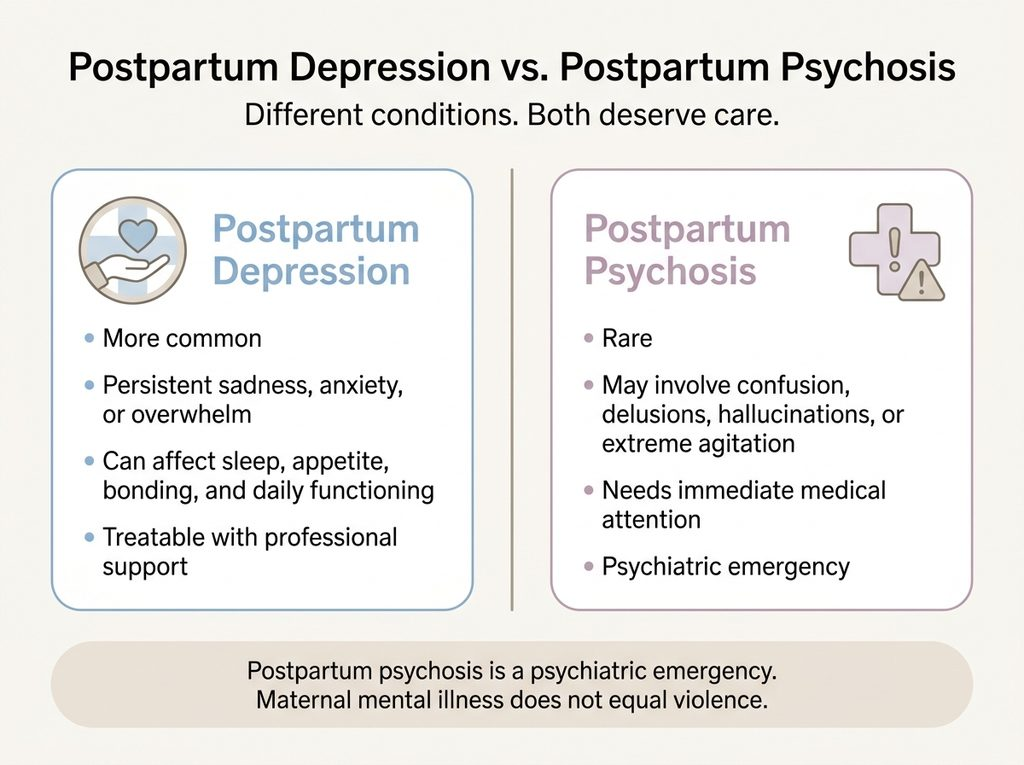
Any discussion of a case like this must make an important distinction: postpartum depression and postpartum psychosis are not the same condition.
The National Institute of Mental Health describes postpartum depression as a serious mood disorder that can occur after childbirth. It may involve persistent sadness, anxiety, hopelessness, exhaustion, loss of interest, difficulty bonding with the baby, changes in sleep or appetite, or thoughts of self-harm. The Centers for Disease Control and Prevention has reported that postpartum depressive symptoms affect a significant share of new mothers, commonly summarized as about one in eight women in the United States.
Postpartum depression can be debilitating. It can also be treatable, especially when recognized early and met with appropriate care, which may include therapy, medication, social support, and medical monitoring.
Postpartum psychosis is rarer and more acute. It can involve hallucinations, delusions, severe confusion, paranoia, extreme agitation, or a break from reality. It is widely treated as a psychiatric emergency because it can escalate quickly and may involve risk to the mother, infant, or others.
Conflating the two creates harm. If postpartum depression is discussed only in the shadow of violence, many mothers may fear disclosing symptoms. If postpartum psychosis is minimized as ordinary sadness, families and clinicians may miss an emergency. The responsible public message is clear: postpartum depression is common and treatable; postpartum psychosis is rare but urgent; both deserve medical attention rather than shame.
That distinction also protects against a dangerous oversimplification. Maternal mental illness does not equal violence. Most mothers experiencing postpartum depression or other perinatal mental health conditions do not harm their children. At the same time, rare tragedies involving severe mental illness should not be stripped of their medical and social context simply because the facts are painful.
When maternal crisis reaches the criminal courts, society is already responding late.
Courts can weigh responsibility, evidence, public safety, and legal standards for mental illness. They can punish, confine, acquit, or order treatment within the limits of the law. But they are not designed to function as the first line of mental-health detection. By the time a mother’s psychiatric condition becomes a matter for prosecutors and judges, opportunities for earlier intervention may already have been missed.
The Constance Fisher case raises precisely this uncomfortable issue. Historical accounts suggest that the system’s response became part of the public controversy around the case. But the larger lesson is not whether a past court was too harsh or too lenient by today’s standards. Without a fully verified record, sweeping claims about legal decisions would be irresponsible.
The broader point is more durable: criminal justice systems have long struggled with mental illness, especially when symptoms are entangled with acts that produce public horror. A legal system asks, “What happened, and who is responsible?” A public-health system asks, “What warning signs were present, what support was missing, and how can future harm be prevented?”
Both questions can matter. But if the second question is ignored, society learns too little.
The way a case is described shapes what the public learns from it.
A sensational headline may attract attention, but it can also flatten reality. It can turn dead children into narrative devices and a distressed mother into a monster, a curiosity, or a symbol. That kind of coverage rarely helps readers understand maternal mental health. It also may discourage families from seeking help when early symptoms appear.
More careful language does not mean sanitized language. The deaths of children should be acknowledged with gravity. The suffering of surviving family and community members should not be minimized. But public-interest journalism can hold those truths while still asking what social conditions made intervention unlikely.
In the context of a 1954 Maine tragedy, the most important story may not be the most lurid detail. It may be the silence before the crisis. It may be the lack of screening. It may be the absence of accessible psychiatric care. It may be the pressure on mothers to hide distress because admitting it could threaten their identity, reputation, or family stability.
Those are not excuses. They are conditions. And conditions can be changed.
Modern maternal mental health care is far from perfect, but the framework has improved.
Today, major medical organizations recognize perinatal mental health as a significant area of clinical care. The American College of Obstetricians and Gynecologists recommends screening for depression and anxiety during pregnancy and after birth. Pediatric visits, obstetric follow-ups, and primary-care appointments can all become points of contact for identifying distress.
Public-health agencies now publish resources for postpartum depression. Hotlines and crisis services exist for people at immediate risk. Treatment options are better understood. The public vocabulary has widened enough that many mothers can now say, “I think something is wrong,” and be met, at least in theory, with care rather than condemnation.
The cultural conversation has changed too. More women speak openly about postpartum depression, intrusive thoughts, traumatic births, isolation, and the shock of early parenthood. That openness matters. Shame thrives in silence; treatment begins with recognition.
Yet improvement should not be mistaken for success.
Even today, maternal mental health support is uneven. Screening does not guarantee treatment. A mother may be asked the right questions and still be unable to access a therapist, afford medication, arrange childcare, take leave from work, or disclose frightening symptoms without fear of judgment.
Some families still do not know the difference between exhaustion and clinical depression, or between anxiety and a psychiatric emergency. Some mothers still minimize their symptoms because they believe suffering is part of being a “good” mother. Others fear that honesty will automatically lead to punishment or separation from their children.
The stigma is especially dangerous around thoughts that feel unacceptable. Many postpartum mental health conditions can include intrusive thoughts: unwanted, distressing thoughts that horrify the person experiencing them. These are not the same as intent to harm. But when mothers do not have a safe way to describe them, they may suffer alone. In more severe cases, where psychosis or loss of touch with reality is present, the need for immediate medical intervention becomes urgent.
That is why maternal mental health cannot be treated as a private problem managed behind closed doors. It is public health infrastructure. It requires trained clinicians, informed families, accessible care, emergency pathways, and a culture that does not force mothers to perform wellness when they are in crisis.
The hardest part of writing about a domestic tragedy is maintaining moral clarity without collapsing into moral simplicity.
Children died. That fact must remain central. Their lives should not be used merely as a pretext for commentary about systems, stigma, or medicine. At the same time, refusing to examine the surrounding context does not honor them. It only preserves the conditions under which future tragedies become more likely.
The point of revisiting a case like Constance Fisher’s is not to relitigate every detail from a distance. It is to ask what the past reveals about the present. In 1954, the language of postpartum depression was not widely available to the public. Postpartum psychosis was not understood in the way it is now. Courts, newspapers, doctors, families, and communities operated inside a narrower frame.
Modern society has a wider frame. That creates responsibility.
The enduring lesson of this 1954 Maine tragedy is not that every past tragedy can be neatly explained by a modern diagnosis. It cannot. Responsible analysis must avoid unsupported retrospective certainty.
The lesson is that misunderstanding maternal mental health carries a cost. When mothers are expected to endure quietly, warning signs disappear. When mental illness is treated primarily as shame, families delay care. When courts become the first institution to fully confront a psychiatric crisis, intervention has come too late.
Postpartum depression should be recognized early. Postpartum psychosis should be treated as an emergency. Mothers in distress should be met with seriousness, not suspicion alone; support, not sentimentality; treatment, not silence.
The past cannot be repaired. But it can be read honestly. And if cases like this still have public value, it is because they remind us that maternal mental health is not a private weakness. It is a shared obligation.
Read more about the history, health systems, and social conditions that shape how families experience crisis—and how better understanding can help prevent future harm.