



Newsletter Subscribe
Enter your email address below and subscribe to our newsletter

Ideas Worth Building

AI may help researchers decode patterns in whale songs, dolphin clicks, bird calls, and other animal signals. But the rise of AI animal communication is also raising new questions about privacy, consent, and animal welfare.
The idea sounds like science fiction: a future app listens to a whale song, a dolphin click, a bird call, or a dog’s bark and tells humans what the animal is “saying.”
That future is not here yet. But AI animal communication research is moving quickly enough that scientists, technologists, and ethicists are beginning to ask a new question: if humans gain the ability to interpret more of what animals communicate, do animals have any right to privacy?
Recent public discussion, including coverage by the New York Post, has framed the issue in a provocative way: artificial intelligence may one day help humans talk with animals, but decoding animal signals could also cross ethical boundaries. The most responsible answer is more nuanced. AI is not currently translating full animal languages the way a human translator converts French into English. What it can do is identify patterns in sounds, movements, and behaviors at a scale humans could never manage alone.
That is still a major shift. For the first time, machine learning animal sounds research may allow scientists to compare thousands or millions of calls, clicks, whistles, songs, gestures, and behavioral cues. The potential benefits are enormous — from conservation to animal welfare. But so are the ethical questions.
When people hear “AI animal communication,” they often imagine a direct conversation: a person asks a dolphin a question, and the dolphin answers in translated English.
That is not what today’s science can do.
Current artificial intelligence animal communication research is mostly about pattern recognition. AI systems can be trained to analyze large datasets of animal vocalizations or behaviors and look for recurring structures. These systems may help researchers identify whether certain sounds are associated with feeding, alarm, mating, social bonding, navigation, distress, or group coordination.
In other words, AI can help detect relationships between signals and context. That is different from proving that an animal has words, grammar, or human-like language.
A responsible way to describe the field is this: AI may help humans better interpret animal communication, but it has not unlocked universal animal translation.
That distinction matters. Animals clearly communicate. Many species use vocalizations, gestures, chemical signals, touch, posture, rhythm, movement, and environmental cues. But communication is not always the same as language in the human sense. A pattern in whale clicks or bird calls may carry important information without mapping neatly to a sentence.
Animal language research has always faced a practical problem: animals produce huge amounts of data, and much of it is difficult for humans to detect or classify.
Some animals communicate outside the range of human hearing. Others produce rapid sequences of sounds that are hard to separate by ear. Some signals only make sense when matched with behavior, location, social relationships, or environmental conditions.
Machine learning can help by processing large datasets and finding patterns across many variables at once. That makes it useful for studying species such as whales, dolphins, primates, birds, and domestic animals.
Researchers studying whales, for example, can use AI tools to compare vocal sequences across individuals and groups. Dolphin researchers can examine clicks and whistles in relation to social behavior. Primate researchers may study calls, facial expressions, and gestures. Bird researchers can analyze song structures and regional variation. Domestic animal studies may look at whether certain barks, meows, or other signals correlate with stress, attention, hunger, or social interaction.
The strongest work in this area does not treat AI as magic. It combines computation with field observation, biology, behavioral science, and animal cognition research.
That combination is important because an algorithm can find a pattern without understanding what the pattern means. If a model groups certain calls together, scientists still need to test whether those groupings reflect meaningful communication or simply similarities in sound.
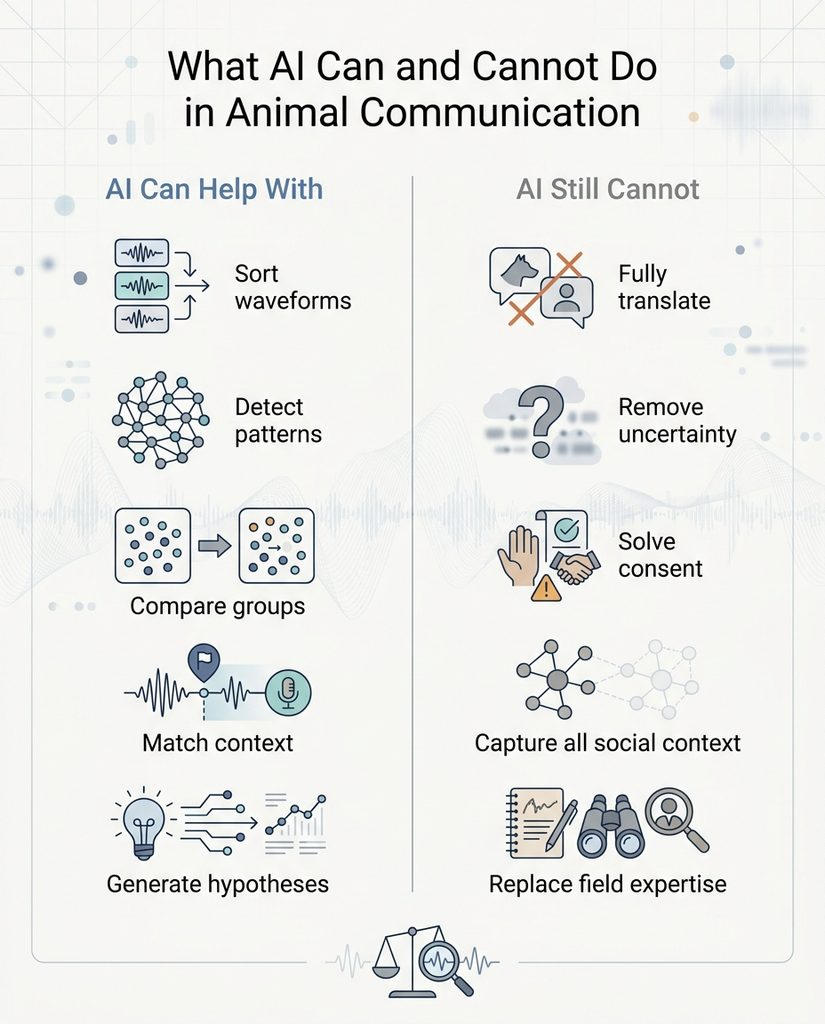
The hype around interspecies communication can easily run ahead of the evidence. For beginners trying to understand the field, it helps to separate current capability from future possibility.
AI can currently help researchers:
– Sort and classify large collections of animal sounds
– Detect patterns in vocalizations, movements, or behaviors
– Compare signals across individuals, groups, and environments
– Identify possible links between communication and context
– Generate new hypotheses for animal cognition research
AI cannot yet reliably:
– Translate animal communication into full human language
– Prove what an animal “means” without supporting evidence
– Confirm consent from animals being studied
– Capture the full social or emotional context of every signal
– Replace field expertise, animal behavior research, or ethical review
This does not make the technology unimportant. It makes it more important to describe accurately.
If a system identifies a whale call associated with a certain behavior, that is meaningful. But saying “the whale said X” may overstate the finding. The better claim is that researchers found a recurring signal associated with a specific observed context.
That may sound less dramatic, but it is how credible science advances.
The most intriguing ethical issue is animal privacy.
Humans usually think of privacy as a human right: the right to keep certain conversations, locations, relationships, or personal information from being monitored or exposed. Animals do not participate in human legal systems in the same way, but that does not make the ethical question meaningless.
If animals communicate with one another, should humans decode every signal they can capture? Should a whale pod’s social calls, a primate group’s warning signals, or a bird’s mating communications be treated as open data? Or could some forms of animal communication deserve protection?
The concern is not that animals are hiding secrets in a human sense. The concern is that communication can be intimate, socially important, or survival-related. Monitoring it at scale may affect animals directly or indirectly.
For example, if researchers decode signals linked to migration, mating, nesting, feeding, or group coordination, that information could be valuable for conservation. But in the wrong hands, similar information could potentially be used to disturb animals, manipulate behavior, locate vulnerable populations, or commercialize interactions.
That is where AI ethics and research ethics overlap. The question is not only “Can we decode this?” It is also “Who gets access, what will they do with it, and how might it affect the animals?”
Human research ethics often relies on informed consent. Participants are told what a study involves, what risks exist, and how their data will be used.
Animals cannot give informed consent in that form.
That does not mean researchers can ignore consent entirely. It means the ethical framework has to be different. Animal research has long used welfare standards, harm reduction, permitting, observation guidelines, and review processes. AI-based animal communication research may need to extend those norms into data collection and data use.
Important questions include:
– Is the data being collected invasively or through passive observation?
– Could recording equipment alter animal behavior?
– Could playback or synthetic signals confuse or distress animals?
– Who owns or controls the communication data?
– Should sensitive locations or behaviors be withheld from public release?
– Could commercial tools encourage people to harass wildlife or overinterpret pets?
These questions are especially important because AI systems can scale quickly. A single field recording project is one thing. A future network of microphones, drones, underwater sensors, and consumer apps constantly gathering animal communication data is another.
The ethical concerns are real, but they do not automatically mean this research should stop.
There are strong potential benefits. Better interpretation of animal communication could help conservationists detect distress, monitor endangered populations, identify habitat disruption, reduce human-wildlife conflict, or understand how animals respond to climate change and noise pollution.
For marine mammals, improved sound analysis could help researchers study how shipping, sonar, and industrial activity affect communication. For birds, automated acoustic monitoring can help track biodiversity. For domestic animals, better interpretation of vocal and behavioral signals could improve welfare by helping humans recognize stress or pain sooner.
The key is proportionality. Research that may protect threatened species or improve welfare has a different ethical profile than entertainment products that claim to let people “chat” with animals without scientific support.
A balanced approach would not reject interspecies communication research. It would demand stronger guardrails as the technology improves.
One of the biggest public risks is not privacy but overconfidence.
Humans are naturally tempted to project human emotions, intentions, and language structures onto animals. AI could make that tendency worse if apps or platforms present uncertain classifications as clear translations.
A dog bark labeled “I am angry,” a whale click labeled “I miss my family,” or a bird call labeled “danger is coming” may feel compelling. But unless those interpretations are backed by rigorous research, they can mislead users and potentially harm animals.
Overtranslation could affect how people treat pets, wildlife, or research subjects. It could also reduce public trust if early claims fail to hold up.
The more responsible path is to communicate uncertainty clearly. AI tools should distinguish between a confirmed association, a probable context, and a speculative interpretation.
As the field develops, researchers and technology companies may need standards designed specifically for animal communication data.
Those standards could include:
– Limiting public release of sensitive location or behavioral data
– Avoiding tools that encourage wildlife disturbance
– Requiring welfare review before using playback or generated animal-like sounds
– Labeling AI interpretations with confidence levels and uncertainty
– Keeping conservation and animal welfare ahead of novelty or entertainment
– Consulting animal behavior experts, ethicists, and conservation groups before deployment
The goal should not be to treat animals exactly like humans. It should be to recognize that animals are not just raw data sources. They are living beings with social worlds, needs, and vulnerabilities.
AI animal communication sits at the edge of several big questions: What counts as language? How much can machines reveal about nonhuman minds? Who benefits when animal signals become data? And what obligations do humans have when technology gives them new power over other species?
For now, the most accurate answer is that AI may help humans understand animals better, but it is not yet giving us fluent conversations across species. The breakthrough is not a universal translator. It is a new set of tools for studying communication at unprecedented scale.
That is exciting. It is also ethically complicated.
If interspecies communication becomes one of the next major frontiers in artificial intelligence, the challenge will not simply be learning what animals are saying. It will be deciding when humans should listen, when they should step back, and how to make sure curiosity does not come at the expense of animal welfare.