



Newsletter Subscribe
Enter your email address below and subscribe to our newsletter

Ideas Worth Building

Somatic therapy is a body-based approach to trauma care that focuses on sensations, movement, grounding, and nervous-system regulation. For PTSD, it may be helpful for some people, but it should be understood as an emerging or complementary approach rather than a guaranteed cure.
Somatic therapy has become a popular phrase in trauma care, especially among people looking for approaches that address the physical effects of post-traumatic stress disorder. The basic idea is reasonable: PTSD is not only a set of thoughts or memories. It can also involve sleep disruption, muscle tension, startle responses, digestive distress, numbness, dissociation, panic-like sensations, and a nervous system that reacts as if danger is still present.
But the popularity of somatic therapy has also created confusion. Some descriptions imply that trauma is literally trapped in the body or that a few body-based exercises can release PTSD. Those claims go beyond what the evidence can support.
A more accurate view is this: somatic therapy is a body-based therapy approach that uses awareness of physical sensations, movement, breath, grounding, and nervous-system regulation skills as part of emotional healing. For PTSD, it may be used as a supportive or complementary form of trauma therapy, ideally with a licensed, trauma-informed clinician. It should not replace emergency mental health care or established PTSD treatments when those are needed.
This guide explains what somatic therapy is, how it relates to PTSD, what a session may involve, who may benefit, where the evidence is strongest or limited, and how to choose safe support.
This article is for educational purposes only and is not a diagnosis, treatment plan, or substitute for care from a qualified health professional. PTSD, suicidal thoughts, self-harm urges, psychosis, severe dissociation, and immediate danger require professional support. If you or someone else may be in immediate danger, call emergency services. In the United States, call or text 988 for the Suicide & Crisis Lifeline. If you are outside the U.S., contact your local crisis line or emergency number.
Somatic therapy is an umbrella term for therapeutic approaches that bring the body into mental health counseling. The word somatic refers to the body. In practice, somatic therapy often explores the relationship between emotions, thoughts, bodily sensations, posture, breath, movement, and patterns of physiological arousal.
Harvard Health describes somatic therapy as a form of mental health counseling that emphasizes the connection between emotional distress and bodily sensations or physical responses. That framing is useful, as long as it is not taken to mean that trauma is literally stored in muscles or cells in a simple, mechanical way.
In trauma care, somatic therapy may include approaches such as:
– Somatic Experiencing
– Sensorimotor psychotherapy
– Trauma-informed yoga or movement-based practices
– Breath and grounding practices integrated into psychotherapy
– Body scanning and interoceptive awareness exercises
– Other body-oriented psychotherapies used by licensed clinicians
These approaches vary. Some are structured clinical methods; others are wellness practices that may or may not be delivered by mental health professionals. For PTSD, that distinction matters. A person with clinically significant symptoms should seek care from a licensed mental health clinician, physician, or other qualified professional trained in trauma.
PTSD can occur after exposure to actual or threatened death, serious injury, or sexual violence. Symptoms may include intrusive memories, nightmares, avoidance, negative changes in mood or beliefs, hypervigilance, exaggerated startle, irritability, sleep problems, and difficulty concentrating.
Although PTSD is diagnosed through psychological and behavioral symptoms, it also involves the body. Trauma-related stress responses can affect the autonomic nervous system, endocrine stress systems, sleep, attention, pain perception, muscle tension, and threat detection.
A person with PTSD may know intellectually that an environment is safe, while their body reacts differently. A sound, smell, touch, facial expression, body position, or internal sensation can cue alarm. The heart may race. Breathing may become shallow. Muscles may brace. The person may feel frozen, numb, agitated, nauseated, or disconnected.
This is where the phrase trauma stored in the body often appears. It can be a helpful metaphor if used carefully. Trauma is not best understood as a physical object hidden in tissue. Rather, the brain and body can learn patterns of threat response after overwhelming experiences. Those learned responses can be triggered by reminders, sensations, or contexts that resemble danger.
Somatic therapy aims to work with these patterns by helping people notice bodily cues, regulate arousal, and gradually build tolerance for sensations and emotions that previously felt overwhelming.
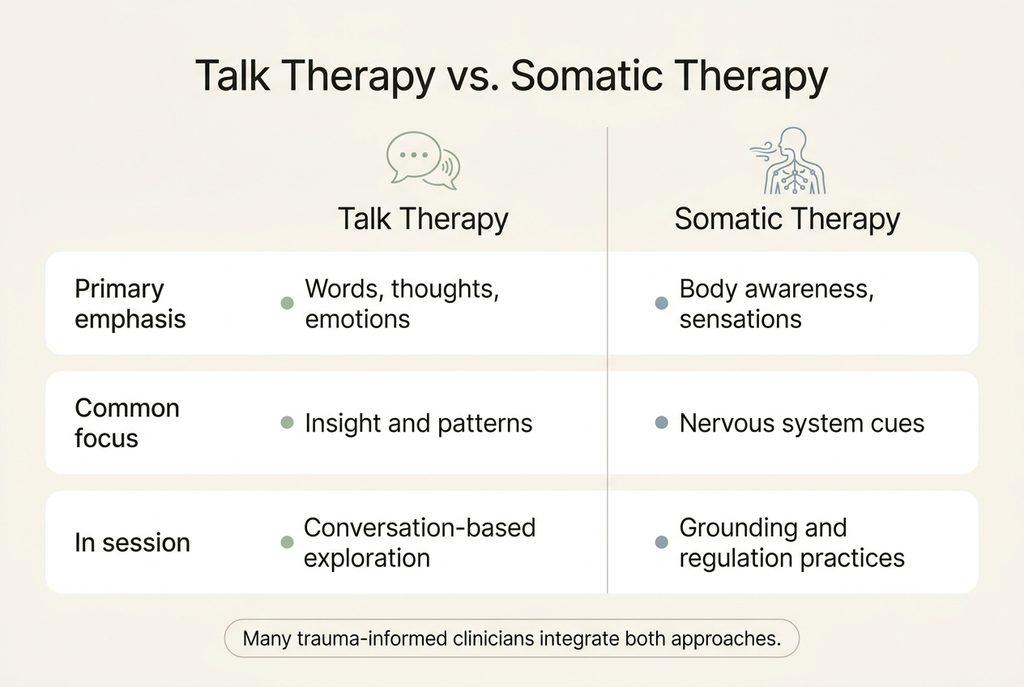
Traditional talk therapy often focuses on language: thoughts, beliefs, memories, emotions, relationships, and behavior patterns. Evidence-based PTSD treatments such as trauma-focused cognitive behavioral therapy, prolonged exposure, cognitive processing therapy, and EMDR may include structured processing of trauma memories, cognitive restructuring, exposure to avoided reminders, or bilateral stimulation.
Somatic therapy adds a different emphasis. Instead of beginning only with the story of what happened, a somatic clinician may ask questions such as:
– What do you notice in your body right now?
– Where do you feel tension, numbness, heat, pressure, or movement?
– What happens to your breath when you talk about this?
– Can you notice one area of the body that feels more settled?
– What helps your nervous system return to a tolerable level of activation?
This does not mean somatic therapy ignores thoughts or emotions. In many forms, it integrates body awareness with psychological work. The goal is usually not to relive trauma in detail, but to build capacity to notice sensations, regulate arousal, and process traumatic material without becoming overwhelmed.
For some people, this can feel more accessible than immediately talking through painful memories. For others, body awareness can feel frightening or destabilizing, especially if they have panic symptoms, chronic pain, dissociation, eating disorder symptoms, or a history of bodily violation. A skilled clinician should adapt the approach accordingly.
Somatic therapy sessions vary by method, clinician training, and client needs. A trauma-informed session should begin with consent, choice, and pacing. The client should not be pushed into intense body sensations or trauma memories before safety and stabilization skills are in place.
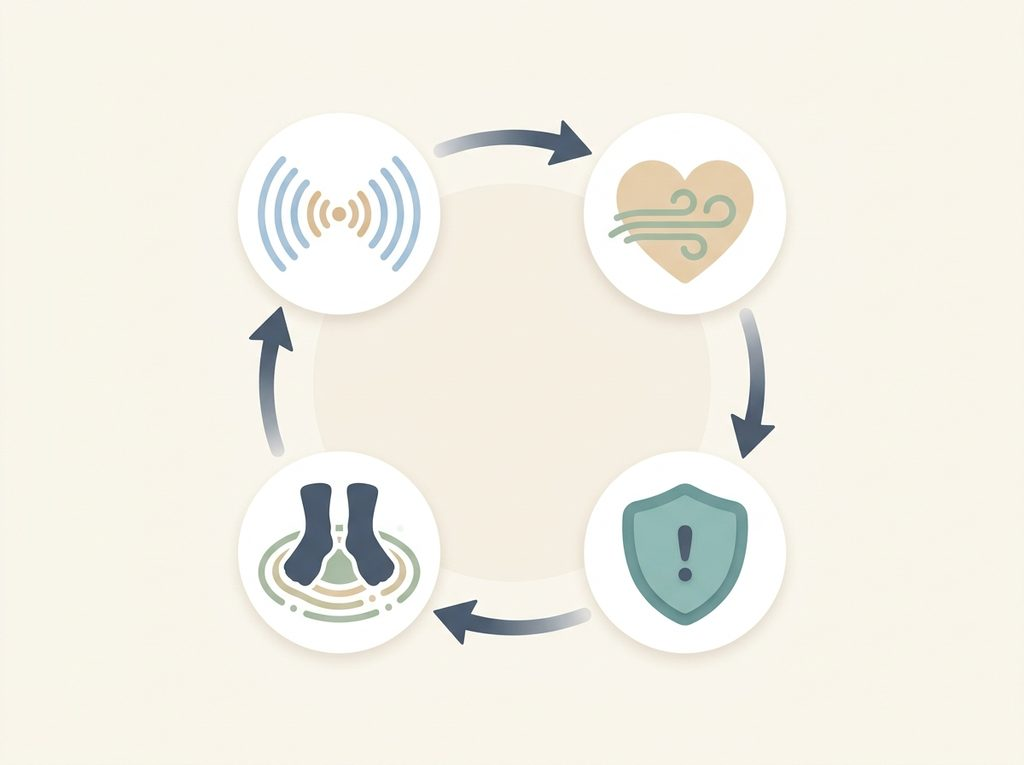
Common components may include the following.
Grounding practices help orient attention to the present moment. A therapist might invite a client to notice the room, feel their feet on the floor, name neutral objects, or track contact with a chair. The purpose is to support a sense of here and now rather than being pulled fully into past danger.
Breath work in somatic therapy is usually gentle. It may involve noticing the breath rather than forcing a specific pattern. For some trauma survivors, deep breathing can be calming. For others, it can increase anxiety or body discomfort. A trauma-informed clinician should avoid one-size-fits-all instructions.
A body scan involves slowly noticing sensations in different areas of the body. This may include tension, temperature, pressure, tingling, numbness, heaviness, lightness, or absence of sensation. The goal is observation, not judgment.
For clients with severe dissociation or panic, body scanning may need to be very brief or avoided until other stabilization skills are stronger.
Resourcing means identifying experiences, images, memories, sensations, relationships, places, or movements that help the client feel more stable, supported, or capable. A resource might be the feeling of a warm mug in the hands, the image of a safe place, a supportive person, a steady posture, or a memory of competence.
In PTSD somatic therapy, resourcing is often used before approaching traumatic material.
Titration means working with small amounts of activation rather than plunging into overwhelming distress. A therapist may help a client notice a manageable sensation related to stress, then return to a neutral or supportive sensation.
This principle is important because more intensity is not always better. In trauma therapy, flooding the nervous system can sometimes reinforce fear, avoidance, or shutdown if not handled carefully.
Pendulation refers to gently shifting attention between discomfort and relative safety, activation and settling, or difficult sensations and more neutral sensations. The intent is to help the nervous system experience movement instead of remaining stuck in high arousal or collapse.
Some somatic approaches include small, mindful movements. These might involve pushing against a wall, noticing an impulse to turn away, stretching, orienting the head and eyes, or tracking the body’s desire to move. The rationale is that traumatic experiences can involve interrupted defensive responses, such as fight, flight, or freeze.
This work should be done carefully. It is not about acting out trauma or forcing catharsis. It is about noticing impulses and building capacity for agency, regulation, and present-time choice.
Somatic therapy is most often discussed in relation to trauma and PTSD, but body-based therapy approaches may also be used for anxiety, stress-related symptoms, grief, emotional regulation difficulties, chronic tension, and some forms of depression. In clinical practice, they may be integrated into broader mental health counseling rather than used as a stand-alone treatment.
The strongest rationale is for people whose distress is closely tied to physiological arousal, shutdown, panic-like sensations, dissociation, or difficulty identifying emotions. For example, a person may understand their trauma cognitively but still feel unsafe in their body. Somatic practices may help bridge that gap.
However, possible benefit does not mean guaranteed effectiveness. The right treatment depends on diagnosis, symptom severity, co-occurring conditions, client preference, safety, and clinician skill.
The evidence for somatic therapy is developing, but it is not as established as several guideline-recommended PTSD treatments.
Major clinical guidelines, including those from the U.S. Department of Veterans Affairs and Department of Defense, the American Psychological Association, and the National Institute for Health and Care Excellence, generally give stronger support to trauma-focused psychotherapies for PTSD. These commonly include trauma-focused CBT approaches, prolonged exposure, cognitive processing therapy, and EMDR.
Somatic approaches are more often described as promising, adjunctive, or emerging. Peer-reviewed reviews of Somatic Experiencing and body-oriented trauma therapies have reported encouraging findings, but they also note limitations such as small study sizes, varied methods, differences in comparison groups, and the need for more rigorous trials.
That distinction is important for researchers and clinicians. A plausible mechanism is not the same as proven clinical effectiveness. The fact that PTSD affects the body does not automatically prove that every body-based intervention treats PTSD. Likewise, limited evidence does not mean an approach has no value. It means claims should be proportional to the quality and quantity of evidence.
A careful summary would be:
– PTSD commonly includes bodily and nervous-system symptoms.
– Somatic therapy targets body awareness, arousal regulation, and mind-body integration.
– Some somatic approaches have preliminary supportive evidence.
– Somatic therapy is less established than several trauma-focused PTSD treatments recommended in major guidelines.
– It may be useful as an adjunct or option for some people, especially when delivered by a licensed trauma-informed clinician.
– It should not be marketed as a cure or used to delay urgent or evidence-based care.
Somatic therapy may be worth discussing with a clinician if a person:
– Has trauma-related symptoms that show up strongly in the body
– Feels chronically tense, braced, numb, frozen, or hyperalert
– Has difficulty identifying emotions but can notice physical sensations
– Becomes overwhelmed when talking directly about traumatic events
– Wants to complement an established trauma therapy with regulation skills
– Prefers an approach that includes mindfulness, movement, or body awareness
It may also be useful for people who have already done cognitive work but still feel physically unsafe or reactive. In those cases, body-based therapy may help them develop a wider range of regulation skills.
Somatic therapy is not risk-free. Paying close attention to the body can intensify distress for some people. A cautious, clinically supervised approach is especially important for people with:
– Active suicidal thoughts or self-harm risk
– Psychosis or mania
– Severe dissociation or frequent loss of time
– Unstable substance use
– Severe panic triggered by internal sensations
– Eating disorders or significant body-related distress
– Medical conditions affected by breathing, movement, or autonomic arousal
– Recent trauma with limited support or safety
This does not mean somatic therapy is always inappropriate for these groups. It means care should be coordinated with qualified professionals and adapted to the person’s stability, medical status, and safety needs.
If a practitioner encourages a client to stop medication, abandon medical care, relive trauma before they feel ready, accept unsupported claims, or ignore worsening symptoms, those are warning signs.
For PTSD, the safest starting point is a licensed mental health professional with trauma training. Depending on location, this may include a psychologist, psychiatrist, clinical social worker, licensed professional counselor, marriage and family therapist, psychiatric nurse practitioner, or physician with relevant expertise.
When evaluating a clinician or program, consider asking:
– Are you licensed to provide mental health care in my state or region?
– What training do you have in PTSD and trauma therapy?
– Do you provide evidence-based PTSD treatments, or can you refer for them?
– How do you use somatic techniques in treatment?
– How do you handle dissociation, panic, suicidality, or destabilization?
– Will I be asked to describe traumatic memories in detail? If so, when and how?
– How do you obtain consent before body-focused exercises?
– Do you coordinate care with physicians or other clinicians when needed?
A trauma-informed clinician should welcome these questions. They should explain their approach clearly, avoid guarantees, respect boundaries, and support informed choice.
It is also important to distinguish licensed therapy from wellness services. Yoga teachers, coaches, bodyworkers, and meditation instructors may provide helpful support for some people, but they are not automatically qualified to treat PTSD. If PTSD symptoms are significant, wellness services should not be the only form of care.
Somatic therapy is a psychotherapy or counseling-related approach, not a medication. Some people with PTSD benefit from medication prescribed by a qualified medical professional, especially when symptoms such as depression, anxiety, insomnia, or severe hyperarousal are present.
No one should stop psychiatric medication because of somatic therapy unless they are doing so under the guidance of the prescribing clinician. Medication decisions should be individualized and medically supervised.
For researchers and evidence-minded readers, somatic therapy raises several important questions.
First, the field needs clearer definitions. Somatic therapy can refer to many different practices, from manualized psychotherapy models to loosely defined wellness exercises. Without precise definitions, it is difficult to compare outcomes.
Second, studies should distinguish stand-alone somatic interventions from somatic techniques added to established trauma therapy. A grounding exercise used inside cognitive processing therapy is not the same as a full course of Somatic Experiencing.
Third, outcomes should include both PTSD symptom measures and functional outcomes such as sleep, avoidance, dissociation, quality of life, and treatment retention. Because somatic therapy often targets physiological regulation, researchers may also explore arousal-related measures, while avoiding overinterpretation.
Fourth, safety reporting matters. Body-based work can be gentle, but it can also bring up intense sensations, memories, or dissociation. Trials and clinical reports should track adverse effects, dropout, and symptom worsening.
Finally, comparative effectiveness research is needed. The clinically relevant question is not only whether somatic therapy helps compared with no treatment, but when it helps, for whom, compared with what, and as part of which treatment sequence.
A more accurate statement is that trauma can shape stress responses, body awareness, movement patterns, and physiological arousal. Muscles may hold tension, but PTSD is not simply a muscle-storage problem.
Some people may experience meaningful relief, but cure language is too strong. PTSD treatment outcomes vary, and established trauma-focused therapies remain better supported by major guidelines.
Some people benefit from approaches that do not begin with detailed trauma narration. However, thoughts, memories, meanings, relationships, and avoidance patterns often still matter. Many effective treatments integrate several dimensions of experience.
Body awareness can be grounding for one person and overwhelming for another. Pacing, consent, and clinical skill are essential.
Seek urgent support now if you or someone else is experiencing:
– Suicidal thoughts, plans, or intent
– Self-harm urges or recent self-harm
– Thoughts of harming someone else
– Psychosis, paranoia, or hearing or seeing things others do not
– Severe dissociation, loss of time, or inability to stay oriented
– Domestic violence, assault risk, or immediate danger
– Inability to care for basic needs
In the United States, call or text 988 for crisis support. If danger is immediate, call emergency services. If you are outside the U.S., use your local emergency number or crisis hotline.
Somatic therapy can be part of healing, but it is not a substitute for crisis care.
Somatic therapy is a mind-body therapy approach that brings attention to bodily sensations, nervous-system arousal, movement, grounding, and regulation. For PTSD, it offers a plausible and often meaningful way to address the physical dimensions of trauma.
The most balanced conclusion is neither dismissal nor hype. Somatic therapy may help some people, especially as part of trauma-informed mental health counseling, but the evidence base is still developing. It is less established than guideline-supported PTSD treatments such as trauma-focused CBT, prolonged exposure, cognitive processing therapy, and EMDR.
If you are considering PTSD somatic therapy, learn more by speaking with a licensed trauma-informed clinician who can explain your options, assess safety, and help you choose care that fits your symptoms, preferences, and level of support.
– Harvard Health Publishing: What is somatic therapy?
– U.S. Department of Veterans Affairs and Department of Defense: Clinical Practice Guideline for Management of Posttraumatic Stress Disorder and Acute Stress Disorder
– American Psychological Association: Clinical Practice Guideline for the Treatment of PTSD
– National Institute for Health and Care Excellence: Post-traumatic stress disorder guideline
– Peer-reviewed reviews and clinical studies on Somatic Experiencing and body-oriented psychotherapy for trauma and PTSD