
Newsletter Subscribe
Enter your email address below and subscribe to our newsletter

Ideas Worth Building
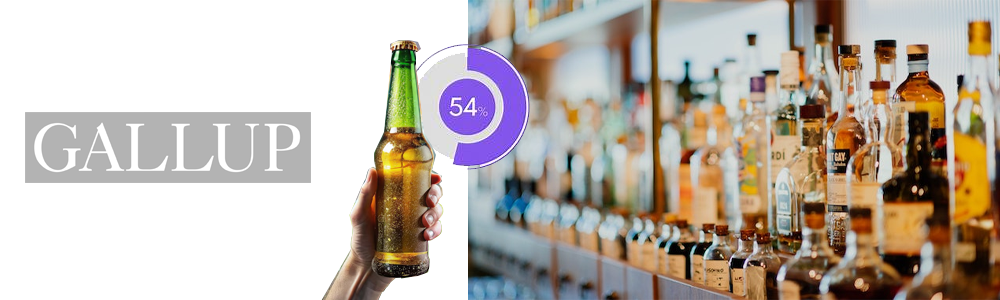
The share of American adults who say they drink alcohol is now tied at its lowest point in Gallup’s long-running trend, offering a striking historical signal about changing health attitudes and social habits.
Gallup’s latest alcohol survey finds that 54% of U.S. adults say they drink alcoholic beverages such as liquor, wine or beer. That matches last year’s result and ties the lowest level Gallup has recorded in a trend that dates back to 1939, before the United States entered World War II.
For researchers tracking alcohol consumption, the finding is notable not only because of the percentage itself, but because it comes amid broader shifts in wellness culture, public health messaging, generational attitudes and the growth of nonalcoholic beverages.
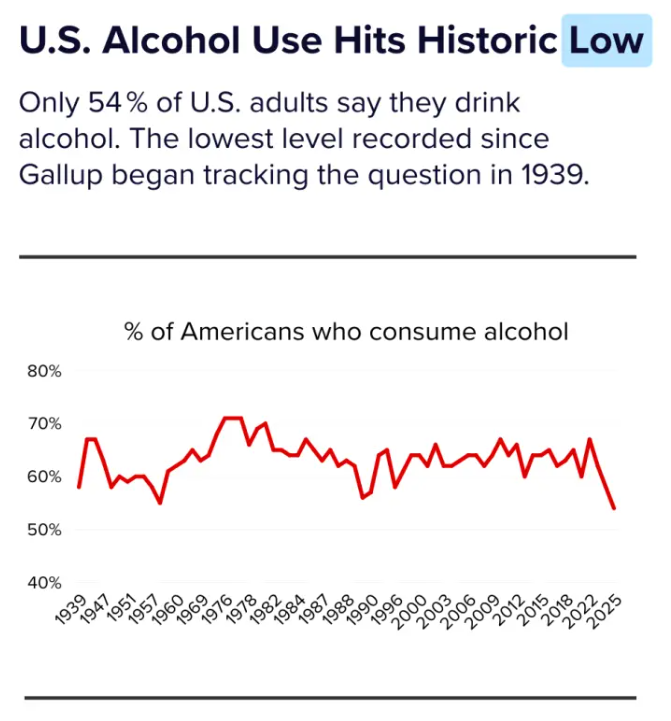
Gallup’s long-running measure asks adults whether they personally drink alcohol. The question wording reported by Gallup is: “Do you, yourself, happen to drink alcoholic beverages such as liquor, wine or beer?”
According to Gallup, the latest result comes from its July Consumption Habits poll, conducted July 7-21, 2025, among 1,002 U.S. adults. The margin of sampling error is plus or minus 4 percentage points.
The result does not mean alcohol has disappeared from American life. A majority of adults still report drinking. But the Gallup poll suggests that drinking rates have moved to the low end of the organization’s nearly nine-decade historical trend.
Gallup’s alcohol consumption trend is useful because it has asked a similar basic question across generations. That makes the latest reading a broad indicator of cultural change, even though it does not capture every dimension of alcohol use.
The survey measures whether people say they drink at all. It does not, by itself, measure how often people drink, how much they consume, whether they binge drink, or whether they meet clinical criteria for alcohol use disorder. Those questions are tracked more directly in federal data sources such as the Substance Abuse and Mental Health Services Administration’s National Survey on Drug Use and Health.
Still, the Gallup poll is valuable because it captures a simple social marker: whether American adults identify as drinkers. A record-low or tied-record-low reading suggests that abstaining from alcohol may be becoming more common, more socially acceptable, or both.
Gallup has also reported that Americans are increasingly likely to view moderate drinking as harmful to health. That change in risk perception may be one factor behind Americans drinking less, though the poll alone cannot prove causation.
Public health agencies have emphasized that alcohol use carries health risks. The Centers for Disease Control and Prevention links excessive alcohol use to injuries, liver disease, heart disease, certain cancers and other health harms. The National Institute on Alcohol Abuse and Alcoholism also notes that alcohol affects multiple organs and is associated with both short-term and long-term risks.
The World Health Organization has taken an especially strong position on alcohol and health, stating that alcohol consumption contributes to disease and injury worldwide and that risk rises with consumption.
For consumers, these messages may be influencing decisions about whether to drink, how much to drink, or whether to seek alternatives. For researchers, the timing raises a useful question: how closely do shifts in risk perception track with changes in self-reported alcohol use?
Several cultural trends may be contributing to lower drinking rates, though each requires careful study.
Younger adults have shown growing interest in wellness, mental health, sleep quality and fitness. Those priorities may conflict with regular alcohol use for some consumers. Social media and digital communities have also helped normalize “sober curious” lifestyles, dry months and alcohol-free social events.
At the same time, the beverage market has changed. Nonalcoholic beverages, including alcohol-free beer, wine, spirits and ready-to-drink mocktails, are more visible in restaurants, grocery stores and bars than they were a decade ago. That growth may make it easier for people to participate in social settings without drinking alcohol.
Economic and social factors may also play a role. Alcohol can be expensive, and some consumers may be reducing discretionary spending. Others may be responding to family history, medication use, pregnancy, religious beliefs, driving concerns or personal health goals.
Gallup’s finding should therefore be interpreted as a broad behavioral signal, not as proof of one cause.
The latest Gallup poll adds to a growing body of evidence that alcohol consumption habits are changing in the United States. But researchers should compare the finding with other data sources before drawing conclusions about public health outcomes.
Key areas to monitor include:
– Whether abstention continues to rise or stabilizes near current levels
– Whether declines are concentrated among younger adults or spread across age groups
– Whether lower drinking rates correspond with reductions in binge drinking or alcohol-related harms
– How risk perception, public health messaging and nonalcoholic beverage adoption interact
– Whether federal alcohol survey data show similar movement over time
The main takeaway is clear: Americans are drinking less by Gallup’s long-running measure, and the latest result places alcohol use at a historically low point. The next research question is why — and whether the shift will continue.
**Read the Research:** Review Gallup’s full alcohol survey report and compare it with CDC, NIAAA, SAMHSA and WHO public health data for a broader view of alcohol health risks and changing drinking behavior.