

Newsletter Subscribe
Enter your email address below and subscribe to our newsletter

Ideas Worth Building
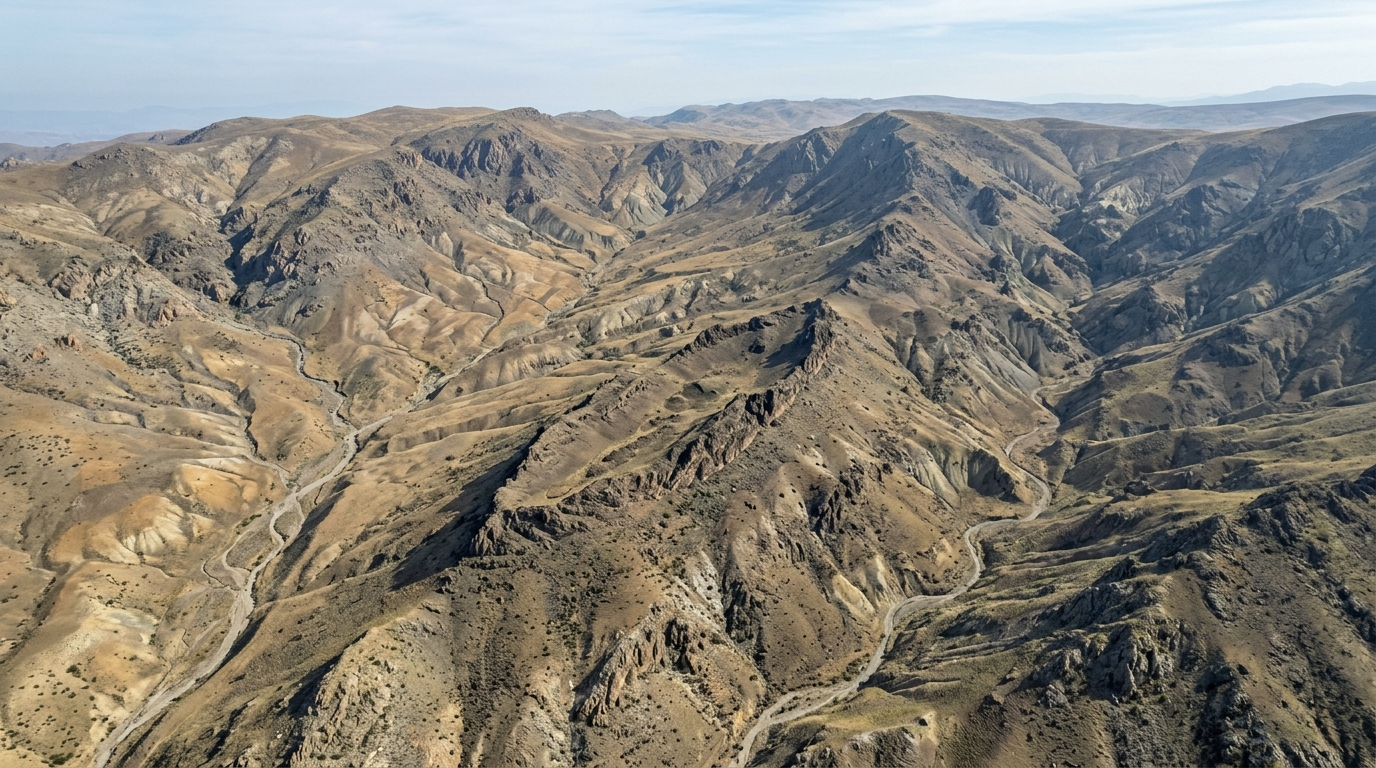
A boat-shaped formation in eastern Turkey keeps fueling Noah’s Ark claims. Here’s what scientists actually know about the Durupinar formation, what remains unproven, and why the mystery persists.
A long, boat-shaped formation in eastern Turkey has become one of the most persistent mystery stories in biblical archaeology. Every few years, a new scan, documentary, expedition, or viral headline suggests that the site may be the remains of Noah’s Ark. The idea is powerful because it sits at the crossroads of religion, ancient history, geology, archaeology, and public imagination.
But has anyone actually found Noah’s Ark?
The short answer is no: no confirmed archaeological discovery of Noah’s Ark has been made. The Turkey site most often discussed in these claims is the Durupinar formation, a natural-looking, boat-shaped feature that has attracted attention because of its outline and its location in a region associated by many traditions with the Ark story.
That does not mean the site is uninteresting. It is interesting precisely because it shows how extraordinary claims are investigated, how natural geology can mimic human-made shapes, and how uncertain evidence can become amplified by viral media.
Here is what scientists, archaeologists, and careful observers actually know about the Noah’s Ark Turkey formation — and what remains unproven.
The Durupinar formation is a boat-shaped geological feature in eastern Turkey. It is often discussed in connection with Mount Ararat and the wider region traditionally associated with the biblical story of Noah’s Ark.
From above or at certain angles, the formation appears to have an elongated, curved outline. That visual resemblance is the main reason it has attracted so much public attention. To people already looking for evidence of a large ancient vessel, the shape can seem suggestive.
Mainstream scientific caution begins here: resemblance is not identification.
Many natural landforms look like familiar objects. Hills, ridges, erosion patterns, mineral deposits, and folded rock layers can produce shapes that resemble boats, walls, roads, animals, or even faces. This is a known problem in archaeology and geology: the human brain is very good at seeing patterns, even when those patterns are not intentionally made.
The Durupinar formation may look boat-like, but a boat-shaped outline alone is not enough to establish that it is a preserved wooden vessel, much less Noah’s Ark.
The connection comes from several overlapping ideas.
First, the biblical Ark story is one of the most widely known ancient narratives in the world. For many people, the possibility of locating a physical object connected to that story is deeply compelling.
Second, the formation is in Turkey, in a region that many Ark searchers consider plausible because of long-standing associations between the Ark tradition and the mountains of Ararat.
Third, the formation’s outline appears elongated and vessel-like. Images of the site are easy to understand and easy to share, which makes it highly effective in documentaries, social media posts, and mystery-focused news coverage.
Fourth, some promoters have pointed to reported scans, subsurface features, unusual materials, or geometric patterns as possible evidence that the site contains the remains of a human-made structure.
Those claims deserve careful examination. But they do not all carry the same evidentiary weight.
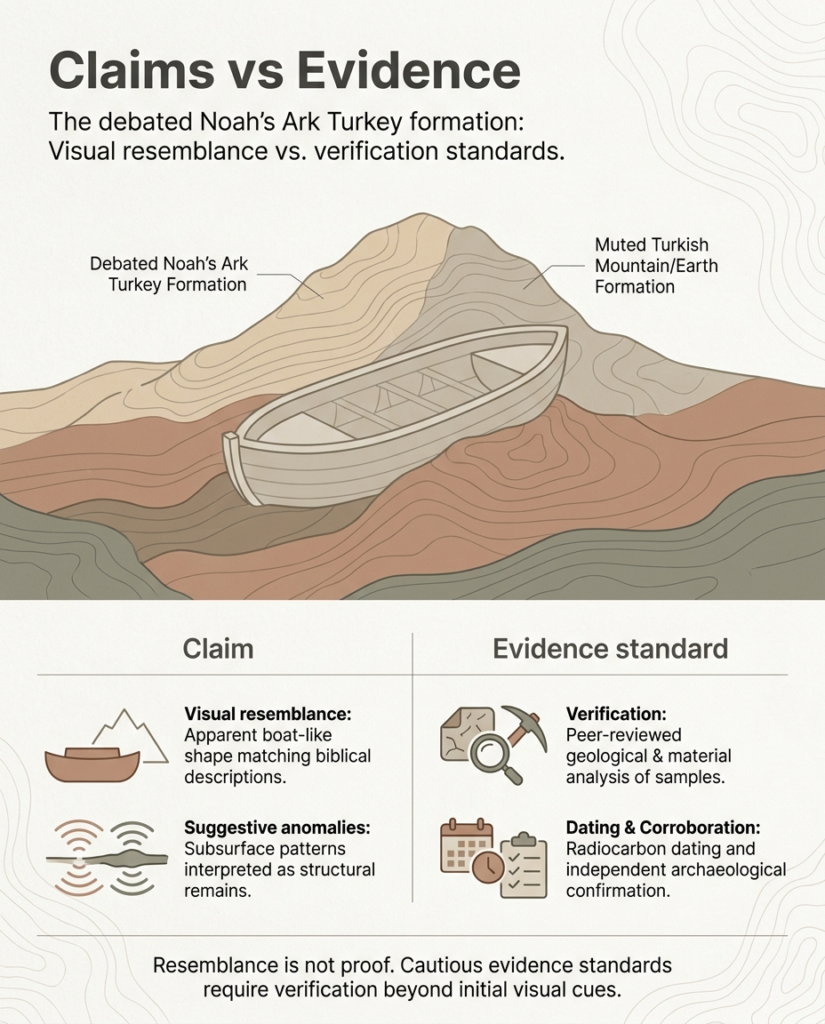
Supporters of the Noah’s Ark interpretation argue that the formation’s outline resembles a large vessel. In popular presentations, this visual resemblance is often treated as the starting point for the claim that the site could be the Ark.
The formation is visually striking. That much is fair to say. But visual resemblance is weak evidence by itself.
Geology often produces suggestive shapes. Erosion can carve smooth outlines. Rock layers can bend, slump, fracture, or weather unevenly. Soil and sediment can accumulate in ways that create borders or ridges that appear artificial when viewed from a distance.
To identify an ancient ship, researchers would need more than an outline. They would need physical evidence of construction, such as preserved structural elements, worked timber, fasteners, tool marks, consistent design features, or datable materials clearly associated with a vessel.
A boat-shaped formation is not the same thing as a boat.
Some reports about the Durupinar formation refer to scans or site investigations that allegedly show subsurface patterns. These are sometimes described as signs of rooms, decks, walls, or other internal structures.
Subsurface scanning technologies can be useful, but they are not magic windows into the past. Ground-penetrating radar and other geophysical tools can detect differences in density, moisture, mineral content, voids, or buried features. They can suggest where something unusual may be present.
They cannot, by themselves, prove that a feature is a wooden ship.
Interpreting scan data requires caution. Natural rock layers, fractures, mineral veins, buried sediment, and erosion patterns can all create signals that look organized. In archaeological work, scan results are usually treated as preliminary evidence. They guide further investigation, but they do not replace excavation, sampling, documentation, and peer-reviewed analysis.
If a scan appears to show lines or compartments, the key question is not simply whether the pattern looks interesting. The question is whether the pattern can be independently verified, physically sampled, and shown to be artificial rather than geological.
So far, no publicly established scientific consensus has confirmed that scans of the Noah’s Ark Turkey formation reveal the remains of an ancient wooden vessel.
Some Ark-related claims point to unusual materials at or near the Durupinar formation. These may be described in popular coverage as evidence of human-made construction, ancient wood, metal fittings, or other artificial components.
Unusual material is not automatically archaeological material.
A credible archaeological claim requires context. Where was the material found? Was it in place, or could it have been moved? Was it documented during a controlled investigation? Was it tested by qualified laboratories? Were the results published in a way that other specialists can evaluate? Can the sample be connected directly to the formation and to a human-made structure?
Without that chain of evidence, material claims remain uncertain.
This is especially important at famous sites. Once a location becomes associated with a major claim, objects found nearby can be interpreted through expectation. A stone, mineral deposit, fossilized material, or piece of old organic matter may seem meaningful because of the story surrounding the place.
Scientific analysis has to separate the object from the expectation.
For the Durupinar formation to be accepted as Noah’s Ark, researchers would need clear evidence of human workmanship and materials consistent with a constructed vessel. That evidence has not been confirmed by mainstream archaeology.
Some discussions suggest that if the formation or material around it can be dated to an ancient period, that would support the Ark claim.
Dating is essential, but dating alone is not enough.
A geological formation in eastern Turkey can be old without being a ship. Rock, soil, and mineral deposits may date to periods far earlier or later than any proposed historical event. Organic material found in the area could come from later vegetation, contamination, natural deposits, or unrelated human activity.
To matter archaeologically, a date must be attached to the right kind of evidence.
For example, a date from a piece of wood would only be meaningful if the wood were clearly part of a structure, found in a controlled context, and shown to be associated with the formation itself. Even then, researchers would need to determine whether it represented construction material, later contamination, or something else.
In other words, dating can support a case, but it cannot create one without context.
Extraordinary historical claims require multiple lines of evidence. A confirmed discovery of an ancient vessel at the Durupinar formation would likely require all or most of the following:
– Clear physical remains of human-made construction
– Materials consistent with a wooden vessel rather than natural geology
– Controlled excavation or sampling by qualified researchers
– Independent laboratory testing
– Transparent documentation of where samples came from
– Peer review or evaluation by relevant specialists
– Geological analysis showing the formation is not natural
– Archaeological context connecting the evidence to an ancient structure
That is a high bar, and it should be. A claim involving Noah’s Ark would not be a minor site interpretation. It would be one of the most consequential archaeological announcements ever made.
Because of that, the evidence would need to be exceptionally strong, repeatable, and open to scrutiny.
Geologists tend to approach the Durupinar formation as a landform first. The question is not, “Could this be the Ark?” but “What natural processes could explain this shape?”
That is not dismissive. It is how geology works.
Natural processes are often enough to explain unusual formations. Folded rock, erosion, landslides, sediment movement, and mineral patterns can create shapes that appear artificial. In landscapes shaped by tectonic forces and erosion, long curved forms are not inherently surprising.
The burden of proof rests on the claim that the formation is artificial. Until there is strong evidence of construction, the more cautious interpretation is that the Durupinar formation is a geological formation in Turkey that happens to have a boat-like outline.
Archaeology depends on context, documentation, and comparison. A site is not accepted as an ancient structure because it resembles something from a story. It must contain evidence of human activity that can be documented and interpreted in relation to other known evidence.
For the Durupinar formation, the major problem is not lack of public interest. It is lack of confirmed archaeological proof.
No widely accepted archaeological finding has demonstrated that the formation contains the remains of Noah’s Ark. No confirmed excavation has produced an undisputed ancient vessel. No scientific consensus has identified the feature as a human-built ship.
This distinction matters. Saying “the claim is unproven” is not the same as saying “the tradition is meaningless.” Religious tradition, historical memory, and archaeological evidence are different categories. They can overlap, but one does not automatically validate the other.
A respectful approach allows religious readers to understand why the story matters while also recognizing that archaeology has evidentiary rules.
The Durupinar formation is almost perfectly designed for viral curiosity.
It has a recognizable shape. It is connected to one of the world’s best-known ancient stories. It is located in a dramatic landscape. It can be explained in a single headline. And it leaves room for uncertainty, which makes people want to click, argue, and investigate further.
That uncertainty is often where exaggeration enters.
A headline may say a discovery “could prove” Noah’s Ark. A documentary may emphasize the most suggestive images. A social media post may turn a cautious scan interpretation into a declaration that the Ark has been found. Over time, the difference between “interesting feature,” “possible anomaly,” and “confirmed discovery” can disappear.
But those categories are not interchangeable.
Scientific uncertainty should not be converted into certainty for the sake of a better headline.
When evaluating claims about Noah’s Ark in Turkey, it helps to ask a few simple questions:
1. Is the claim based on physical evidence or visual resemblance?
2. Has the evidence been independently tested?
3. Are qualified geologists and archaeologists involved?
4. Is the data publicly available for review?
5. Could natural processes explain the feature?
6. Does the claim distinguish belief, interpretation, and proof?
These questions do not require anyone to reject religious tradition. They simply help separate faith claims, historical interest, geological interpretation, and archaeological evidence.
That separation is essential if the goal is truth rather than sensation.
No confirmed discovery of Noah’s Ark has been made.
The Durupinar formation remains a fascinating and controversial site because it looks like a boat, sits in a region associated with Ark traditions, and continues to generate claims based on scans and interpretations. But the available evidence does not establish that it is an ancient wooden vessel.
The most careful conclusion is this: the Noah’s Ark Turkey formation is an intriguing geological feature, not a confirmed archaeological discovery.
That may feel less dramatic than the viral version of the story, but it is also more accurate. The site is worth studying as geology, as cultural history, and as an example of how ancient narratives shape modern exploration. What it has not yet provided is proof that Noah’s Ark has been found.
For readers interested in the evidence behind these claims, the best next step is to read the research carefully, compare the archaeological and geological interpretations, and pay attention to what has actually been demonstrated rather than what has merely been suggested.